Search This Blog

Tuesday, 29 August 2017

Deadly Words

•••••Deadly Words•••••

“For all sad words of tongue and pen, The saddest are these, 'It might have been'.” - John Greenleaf Whittier

I am a storyteller and a peddler of words. I know that words and how we use them have tremendous power. The right words at the correct time can spell the difference between victory and defeat, success and failure or even life and death. I agree with Mr. Whittier that "It might have been." are truly among the saddest of words. They are the eulogy for a dream.

However, before one can get to a point of such regret it would be necessary to exhaust one's opportunities. Dreams do not expire overnight. If the possibility still exists there would be no need for such lament. Only when an opportunity is completely passed will a dream die.

As we travel through life we all have dreams. We have dreams about what we will be, who we will make a life with, the family we will create or even fame and fortune. Some are naive, like the fantasies of children to become princesses and knights. Others evolve over time like our education and career paths. Meanwhile other ambitions develop out of necessity, like health and fitness needs.

All our dreams are important. They bring us hope and focus our energy and efforts. Aspirations and our efforts to achieve them bring us life and vitality. If a dream is worthwhile then we should never lightly abandon it. It is our worthwhile goals that will haunt us when we fail to follow them. These are the ones that become "It might have been."

In my own travels I have discovered two deadly words that are dream killers. We use these words to excuse ourselves and to blame our circumstances. They make us feel less guilty when we surrender our goals. These words soothe our lack of faith in ourselves. What are these lethal words? They are: I'm trying.

They seem so harmless, so benign. Make no mistake, those words spell the demise of your dreams. If someone asks you about your dream and you reply with "I'm trying such and such and this and that." then beware, you are courting regret. Trying is weak. It implies lack of commitment, responsibility and control. Trying is just waiting for the universe to swoop in and crush our hopes.

When we try then we are leaving room for the word 'but'. I'm trying to lose weight *but* I have plateaued. I'm trying to get promoted *but* no one is giving me the opportunity. 'Trying' and 'but' always seem to be paired. When it comes to dreams and goals they are a fatal pair.

There is a simple way to change your thinking and avoid these deadly words. Simply pay attention to your use of the devilish duo. When they are on your lips, stop and instead say what you are actually doing rather than what you are attempting. Talk about the concrete steps that you are actually making towards your goals. Don't talk about trying to write a book. Talk about what you have written, what you are writing and the publishers that you've approached. Don't talk about trying to lose weight. Talk about the good habits you have started, learning to count calories or the physical activities that you've begun.

Take responsibility for your dream. Make it happen one step at a time. Of course you can't control all the variables in life, but that doesn't mean you merely try to pursue a goal. You break it down into actions that you can do. Deal with variables one by one as they arise. Remind yourself of what you are doing, not what you are trying.

Don't abdicate a dream to luck, chance or fate. It will haunt you. If it is a worthy dream then it is worth the action and commitment. You will never regret time spent on a worthwhile goal, even if it may never fully realized. Your honest progress will be rewarding. While a lack of effort for such a dream will ignite justified remorse.

Give your mind and heart a better outlook by banning the killer 'I'm trying...' from your vocabulary. Protect your dreams from these poisonous words that subtly sabotage your thinking.

©2017 S.D.Wilson

Monday, 10 July 2017

The Gain Within Pain


_____The Gain Within Pain____

“Every problem or difficulty you face contains the seed of an equal or greater advantage or benefit.” –Napoleon Hill

Maybe I am odd but I got used to this viewpoint when I was young.  Yes, there may be exceptions.  Yet the vast majority of the time I have found that our troubles hold the beginnings of our greatness, the nuclei of our success.

Think of the caterpillar.  Great energy and effort go into the creation of a cocoon or chrysalis.  The creature goes from daily foraging, eating and avoiding predators to spending weeks cooped up and inactive as the painfully slow processes of metamorphosis take place.  If it has thoughts does it grow impatient day by day?

Ah, but all that work and waiting one day results in a complete transformation.  In one final struggle and momentous effort, our earthbound worm frees itself from its bonds to finally take flight.   We cannot know the thoughts, if any, of a caterpillar.  Nonetheless, it is clear that process that transforms an awkward worm into an elegant butterfly or a moth involves sweat and difficulty.  Yet that labour is the beginning of greatness for the creature as it leaves behind its former limitations.

What are you facing today?  Is a slow tedious process teaching you patience?  Is a difficult and stressful situation instructing you on perseverance?  Is an interaction with a harsh and difficult person coaching you on tolerance and kindness?   Is exhaustion and despair showing you the need to say ‘no’ others and to address your own welfare?  Look at your struggles.  They are not merely curses and deficits.  If you stay open to possibilities then you will see within your trials the buds of possible metamorphosis.  If you let it, your patient overcoming of a situation can literally transform you to soar beyond your current existence and expectations.

©2017 Scott D. Wilson

Tuesday, 4 July 2017

Breaking Free of Your Thoughts


–Breaking Free of Your Thoughts–


“You will never be free until you free yourself from the prison of your own false thoughts.” –Philip Arnold

In the TV series “House M.D.” the main character’s tagline and principle philosophy is “Everyone lies.” It is cynical but unfortunately also largely true. However, like Dr. House, we often focus on the external lies that we tell others. The reality is that before we lie to others we first and foremost lie to ourselves. It is with those false thoughts, one by one, that our personal prison walls are built:

- I’m not pretty enough
- Others can. I can’t.
- I’m not smart enough
- They are special. I’m not.
- I’m not smart enough
- I just have bad luck.


We wall ourselves in making our world smaller and smaller. Our meager expectations become our limits. Creativity is for the artistic and the talented. Invention and innovation are for the gifted and the bright. Our fears solidify into concrete barriers that we never dare to test. Risks become the things that the lucky and the special people take, not us. Safety becomes our prime directive, and there we remain safe and sterile. Change is both dangerous and uncomfortable and to be avoided.


Sure, most of us decorate our cells with all the many comforts of life and we dream that are truly free while all the while our minds yearn to think free and follow the passions of our hearts. Make no mistakes, the prison bars are there in our thinking and our fears guard the doors to freedom. If we truly want real liberty then we must begin to challenge our own beliefs about ourselves. When we reach an apparent limit and we hear our thoughts screaming “I can’t” or “I’m not” that is when we must stop and confront our own words and thinking. I am not exaggerating when I tell you that your freedom may lie just beyond “I cannot” and “I am not.”


Professional athletes know that the barrier between better and best is not physical, but mental. They must humble themselves mentally by admitting that they may not know the true boundary of their bodily abilities. Skill and talent take one so far but to achieve our utmost our minds need to be free enough to believe beyond the limits that we perceive. I know that we are not all called to challenge our physical bodies to the same degree as skilled runner or a prima ballerina. However, we all have the same ability dream and imagine and to drive our own abilities further.


Our minds are powerful devices and truly without limits. We can conceive the most marvelous and amazing things. In my lifetime many miracles have been achieved through science and technology that most thought would be impossible. In days gone by many learned people argued that man would never fly, and now we not only tour the globe but we blast into the depths of outer space. If the brilliant minds of the past were wrong about mankind’s limitations then could you be in error about your own?


If you truly desire real freedom then start with your mind. If you are not following your dreams or achieving your goals then take some time to look at your reasoning and excuses. Pay attention to those “cannots” and “are nots.” When you hit one of your believed limits then stop and take some time to deal with it. Write it down if you need to do so. Now imagine if that limit did not exist. Dream about the ways around your problem. Let your mind wander and wonder.


Earl Nightingale, the great self-improvement pioneer, encouraged people set aside time daily to look at their dreams and their challenges. He reasoned that this discipline would engage our hearts and minds to create the pathways to our solutions and our dreams. The goal would remain fresh in our conscious and unconscious thoughts and innovative possibilities would arise and come to mind. This is true as long as these ideas don't get caught and tangled in our false thinking.

If we truly want the freedom to grow, change and succeed then we need to liberate our minds. We need to address and question our limiting thoughts. Daily, bring your goals to mind and allow yourself the time regularly to dream and create new solutions. Break your heart and mind out of your prison of false thoughts and set them free overcome the fears and illusions that once limited them!


“Your mind can be either your prison or your palace. What you make it is yours to decide” ―Bernard Kelvin Clive

Cheers!
©2017 S.D. Wilson

Monday, 19 June 2017

Are you offensive? Yes, good!

Are you offensive?  Yes, good!
By Scott Wilson

“Action Offends the Inactive” –Chris Shugart

I have covered an aspect of this subject once before using the analogy from the film ‘the Matrix’ and becoming unplugged.  However, my focus was more about projecting our own expectations upon others than about their reactions towards us.  I would like to cover here something that surprises so many people who seek to make improvements in their lives.

If you have set a goal and you are visibly putting in the effort daily to achieve that goal then I have news for you:  You are offensive to many of those around you.   Yes, you heard me.  You are a thorn in the side of some of your friends, family and acquaintances.  You are going against the flow.  Who do you think you are?  What makes you think that YOU deserve something better than everyone else?  What makes you special?

Sure, the people that you know may not actually make these statements but their words and actions will reflect the sentiment.  A colleague will make sideways comments about your improvement efforts.  A loved one will subtly discourage you from proceeding with your commitment to better yourself.  There will be some strong push from peers to go along and conform to the norm.  It surprises many people that the ones that are closest to them are often the source of their worst discouragement and temptations to quit.

You see, if you are successful in your efforts then others who see you will ask themselves “Why can’t I do what he or she did?” That is a very uncomfortable question.  If you can improve and succeed then that means that they will need to take responsibility for any lack of success and improvement in their own lives.  You are and they aren’t.  In effect, you actions are pointing an accusing finger at their inaction and that is offensive.

Most people want to live relatively comfortable lives free from blame and responsibility.  They are where they because that is where everyone is and that is okay.  Their environment is responsible for all that they have or do not have.  They merely react in response to what is around them.  They did not ask to be born into the life that they are living.  They are simply doing the best with what they have.  Only the special, the lucky, the fortunate and the blessed get anything different.  Good and bad happen by chance and so they are content to be in the middle above the poor and suffering but also below the few prosperous and successful.  Average is just fine for them.

There is nothing wrong with this.  Living a passive life is quite acceptable and billions do it successfully every single day.  Most of the services and systems of our society are geared towards the average person and so this quiet acceptance is encouraged.  However, if anyone wants to leave this comfortable middle ground their efforts are questioned by those around them.  Why unnecessarily risk failure?

Another reason for people’s negative reactions towards you will be fear and resistance to change.  People like to label things.  It makes life easier.  Much of our identities are tied to the labels that have defined us.  Change upsets that.  For example, if you have always been conservative and down to earth and suddenly you start behaving in an excessive and risky manner this will confuse people.  So it is also when we seek to improve.  It will evoke fear to those closest to you.  They will wonder if they truly know you.  They may be concerned that this new and improved version of you may not want to be with them anymore.  They will then act and speak out of this anxiety either consciously or unconsciously.

Whether it is a poor reflection upon themselves or a fear of your changes, those who know you best can be expected to be a source of difficulty for you when you start following a dream or pursuing a goal. This is normal. Accept that you have become offensive to them through no fault of your own.  Don’t be hurt by their comments or actions.  It is a reflection of their own insecurities.  In truth, their responses have very little to do with you.  Instead, take such poor behaviour as proof that you are going in the right direction.  Use such potentially discouraging incidents as fuel to keep you moving on the better path.

Cheers!

©2017 Scott D. Wilson


Friday, 9 June 2017

Losing Fear and Finding Passion

Losing Fear and Finding Passion
By S.D. Wilson

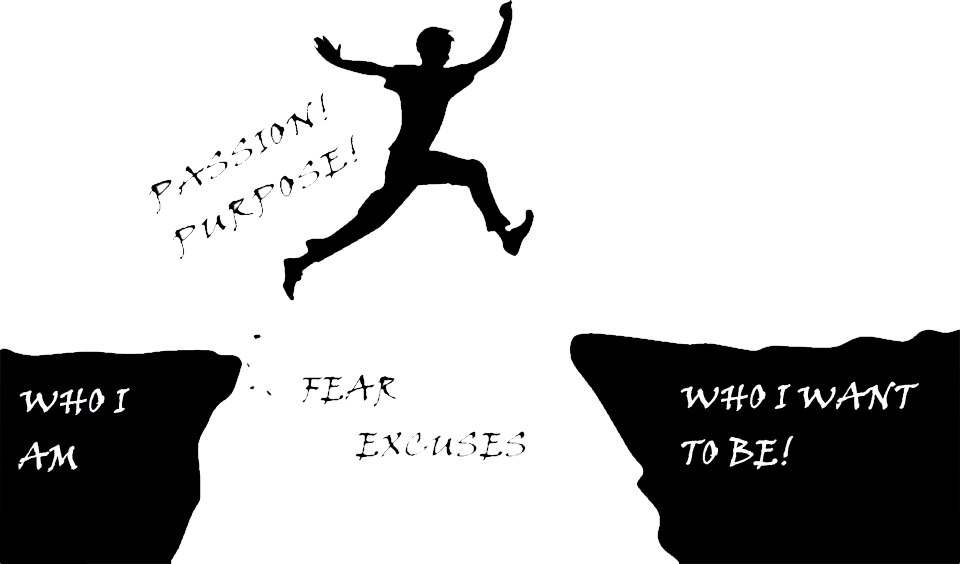
“When your passion and purpose is greater than your fears and excuses, you will find a way.” –Unknown

Ever have something that you really wanted to do?  May be it was a martial art and you were willing to be an awkward novice until you could one day become a graceful master.  Perchance it was a musical instrument where you were prepared to play some sour notes on the way to being able produce a tune that moved people’s souls.  Whatever it was is not important.  The point is that you were willing to be imperfect or even poor at doing something knowing that you would someday become better at it.  You followed your passion and did not stop the first time that you stumbled or struggled to make progress.  Your passion and purpose were greater than your fears and excuses.

Why then do we forget this in so many of our important daily endeavours?  For example, we start exercising and eating better to lose weight.  We are gaining control over ourselves and our behaviours with food and activity.  We want fitness and health.  Then something happens and we are not progressing like we expected.  We are angry at our bodies and ourselves.  We start looking for excuses to quit.   How about when start a new business or attempt a new enterprise in our lobs or careers?  We seem to follow this same pattern and recipe for disappointment.

Many of us seem to suffer attention deficit syndrome when it comes to patiently working towards our goals.  I’ve seen it time and time again in myself and in others. We lose our passion, or worse, we start off dispassionately.  We start something because it is logical and because it seems to be the correct thing to do.  We think that this will be reason enough to keep doing it.  We leave our hearts at the door and expect the mind and body to do all the work.  We are then perplexed when our emotions rise up in protest at being forced into a corner.

You may not need passion to succeed at keeping your teeth clean but I doubt that you will encounter many disappointments or setbacks on the way to grabbing your toothbrush.  The bigger goals in life like health, lifestyle, career, family and such are fraught with discouraging situations and obstacles.  We need our passions to work with us when life throws us curve balls.  I encourage the creation of good habits and routines to minimize our efforts and to lessen our reliance on motivation.  However, when our fears come calling there is only one weapon that can help us overcome them and that is our purpose and our zeal.

With any significant goals there come equally significant fears.  There are great fears of failure, loss, the unknown and change. These fears must be balanced and the opposite of fear is not bravery.  It’s love or passion or zeal.  Fear and anxiety always drive us away from something.  Love and passion always draw us towards something.  Passion and purpose move us to find ways to overcome our fears and obstacles.  It is up to each of us to find our own purpose and drive; otherwise our fears will inevitably sabotage our goals.

So you have set some lofty goals and now the rubber has hit the road.  You have taken action to make your desires into reality.  If this is truly your passion then you have counted the cost and you have already anticipated that difficulty and fear will stand in your way.  Your resolve will be unbending.  Though the path may not be as straight and easy going as you’d like nonetheless you will continue until you have mastered yourself and your objective!  If your heart is not attuned to this quest then the eventual troubles will inevitably derail you.  A person divided within themself cannot stand when opposition occurs; this is a basic principle of combat.  Both your mind and heart need to align for success.

Find your passion!  Find a reason to get out of bed every day beyond the mere need for survival.  You were created to thrive, not to simply survive!  Find the one real thing that makes you feel alive.  Dig deep!  Beware, this may take some time and effort, trial and error.  You may think that you have found an objective or drive only to find that it has waned or changed.  That is okay.  Be patient and keep seeking! Do not be discouraged.  This is a prize worth finding! Success can hinge on your efforts. 

After you have discovered your true passion then everything else can be built upon it: health, family, friends, fame and fortune.  Why should I be fit?  Because your purpose requires it!  Why should I be financially prosperous?  Because that serves your passion! You will know that you have found your passion when a day spent serving it will feel successful no matter the cost and effort and any day that passes without furthering your cause will feel empty no matter how you otherwise benefitted. Once you know your passion and purpose then you will find a way past all your fears and excuses and that way will lead to success!

©2017 S.D. Wilson


Monday, 29 May 2017

Seeking Change


Seeking Change
By S.D. Wilson

"What is necessary to change a person is to change his awareness of himself."  ― Abraham H. Maslow

So you want to be successful?  You need to change and improve things in your life?  Anyone who has ventured down this path knows that self-improvement is difficult.  Changing habits and behaviours that we have lived with up to now often proves challenging.  Abraham Maslow knew this too, as he had studied many people who were successful in changing themselves.  He realized that when embarking on personal change that one of the first things we must change is our awareness of ourselves. 

Each of us walks around with an image of ourselves in our heads.  This image has formed over time and it is an accumulation of views that were given to us by family, friends and society as we grew up.  In addition to their views we have formed our own ideas about ourselves based on life experience in general.  Unfortunately, all of these views have a measure of error in them.  Unless they are significantly challenged then we treat these images as if they were fact.  It reminds me of the words of American philosopher William James:

"Whenever two people meet, there are really six people present. There is each man as he sees himself, each man as the other person sees him, and each man as he really is." 

James used the image of two people meeting to illustrate the difficulties of interacting with our world based on erroneous perceptions of ourselves and others.  This is the root the trouble when we seek self-improvement.  Who is it that we are changing?  How do they think?  How do they feel?  What makes them tick?  If our answers to these questions contain errors and assumptions then our efforts will meet with frustration and ultimately failure.  

You cannot change what you do not understand.  Most of us do not understand ourselves very well. We are somewhat unconscious or unaware of our own make-up.  We have emotions but we do not understand them.  We have thoughts but we do not know what to do with them.  We perceive things and we do not comprehend them and their context.  It is no wonder that most spiritual practices pursue enlightenment, awakening, wisdom, illumination or transcendence.   So valuable is this understanding of oneself and one's environment that people have used every method imaginable to obtain it:  mediation, contemplation, exercise, physical deprivation, dangerous exertion, long journeys, psychedelic drugs, tests of pain and endurance and much more.

Many would mock these people for their efforts.  They would question the payout of their labours.  Yet the value of any success has spurred many people onward in these pursuits for thousands of years.  To succeed in a better understanding of ourselves makes the task of self-improvement so much simpler.  To know who we are and who we are not is powerful.   To understand our strengths and weaknesses, our virtues and our vices, allows one to see and avoid many pitfalls.  By changing our awareness of ourselves we are able to focus our energies where they are most effective and we are less prone to being blindsided.

When you realize that you are naturally impatient then it does not surprise or upset you when you catch yourself being impatient; you can laugh and say "Hello, old friend." When you recognize that you deeply enjoy helping others then you can craft your life so that it fulfills this pleasure more often.  When you come to understand that you respond to boredom and fatigue by seeking the comfort of foods then you can learn to address these stresses with healthier options.  You can uncover your fears and face them.  You can discover your true joys and pursue them.  In short, if your self-awareness changes then you are able to truly make positive changes in yourself.

So if you are seeking improvement and change in your life don't neglect yourself.  Know that changing your self-awareness will make your path to improvement smoother.  Pay attention to your heart, your emotions, your thoughts and your senses.  They will teach you more about yourself than about the people and things that surround you.  Invest the time to get better acquainted with yourself by whatever means work best for you.  Walk, sit, meditate, dance, pray, laugh, sing. find your personal classroom of self-discovery.  Take heed of the wise observations of a man who studied successful people and change how you look at that person on the mirror before you embark on a project to change them.

"One can choose to go back toward safety or forward toward growth. Growth must be chosen again and again; fear must be overcome again and again." ― Abraham H. Maslow

©2017 Scott D. Wilson

Friday, 26 May 2017

Critics for Breakfast

Critics for Breakfast

 “There is only one way to avoid criticism, do nothing, say nothing and be nothing.” –Aristotle
Criticism, it comes from many sources:  friends, family, strangers and even ourselves.  Rarely a day goes by where I do not see posts on here where someone has not been stung in some way by a judgmental thought.  Noble Aristotle makes a very wise point here.  We seem to face criticism for what we do, what we say, what think and what we are.   So we can avoid criticism.  We can largely avoid the slings and arrows of our fellow man and woman: do nothing, say nothing and be nothing. They can’t critique a target that isn’t there.

Or we can accept that there is a cost to becoming something more than we are today.  We can acknowledge that there will always be a source of disparaging thoughts and comments that will be sent in our way as long as we strive for to be better.  We can understand that everyone who advanced was met with detractors and naysayers.  We can know in our hearts and our spirits that mere negative words will be part of the price that we gladly pay to become far more than nothing! Then turn the negatives around with your resolve. Let their “No, you can’t.” be the fuel for your “Oh yes, I can!”

Here’s to a day filled with our potential, bring on the critics…I’m hungry!


©2017 S.D. Wilson