Search This Blog

Showing posts with label fear. Show all posts

Tuesday, 17 September 2019

Applied Power

Applied Power 

“Knowledge isn’t power until it is applied.” 
–Dale Carnegie 
The old adage “Knowledge is power,” is incorrect. Knowledge itself is useless if you do not know how to use it to your advantage. Scientists seek knowledge and understanding of the material world.  As an engineer, I am an applied scientist. I take these discovered scientific principles and apply them to real world situations in order to create things that empower people to do different things.  It is this proper application of information that creates the power.


Thanks to Einstein, most people know that energy equals mass times the speed of light squared.  However, almost nobody in general knows how to meaningfully apply that knowledge.  Here where I work, we take that fact an apply it to create electrical power from the decay of Uranium.  Only when properly applied does knowledge actually become power.  It is also this same knowledge that can be applied to create weapons of unbelievable power and destruction.

Knowledge alone by itself is useless and impotent.  In fact, knowledge can be worse than useless, it can become a trap.  The quest for knowledge can be addictive.  We can get stuck seeking more and more information and all the while never learning to do anything useful with what we have already discovered.  You can see this a to certain degree in the condition described as analysis paralysis; this is where a person never makes a decision and acts on it because they feel they do not yet have enough information to decide properly.  The fear of what they do not know pushes them to know more and evermore.   This thirst for more knowledge can blind us to the truth that we need to act on what we already know.  It reminds me of the biblical text in 2 Timothy 3:7 that speaks to our tendency towards such foolish behaviour:  "(They will be) always learning but never able to come to a knowledge of the truth."

It should be noted that not all knowledge is truth nor can it all be used in a beneficial manner.  For example, you may learn of gruesome and terrible details about a person’s death but that knowledge might serve to do nothing more than give you horrific nightmares.  Meanwhile, other knowledge may be false or at best only true under specific circumstances.   Wrong knowledge applied unwisely has disastrous results, as history has repeatedly shown us in our many foolish crusades and persecutions or people that were feared or reviled.


It is our job as individuals to look at what we know to be true and to act wisely and correctly on that.  Chasing after more information while ignoring what we already know is foolhardy.  If we do not apply what we know right now to be true then the knowledge of that truth stands only to condemn us.   Knowing that we need to eat well and remain active in order to become and stay healthy is of little value if we do not consequently choose to apply that fact to our lives.  If we do not wish to live in guilt about this information then we need to find creative ways that work for us in our diets and our lifestyles.

Clearly, it is not knowledge itself that brings power. Knowledge brings the potential for power through applied action towards a worthy goal.  We must be careful of the trap of knowledge.  If we are not constructively applying what we already know then further learning just adds to the list of things that we are failing to do.  We should not fear the unknown but instead seek new and creative ways to apply what we already know towards our desired objectives.  We need to ask and confirm that the knowledge we have is actually positive and true.  If it is then we should vigorously act on it and apply it to our benefit so that we set ourselves free.

©2018 Scott D. Wilson, P.Eng.

Thursday, 7 June 2018

The Final Frontier


The Final Frontier


“The human mind is the last great unexplored continent on earth. It contains riches beyond our wildest dreams. It will return anything we want to plant.”
–Earl Nightingale (The Strangest Secret)


The curious apes on this terrestrial ball hurtling through the cosmos press ever onward spending billions of dollars sending probes and robots off into outer space where no man has gone before. Meanwhile, we largely ignore the seemingly infinite frontiers of our hearts and minds. Don’t get me wrong. I fully understand the need to explore the external reality in which we live in order to better understand it and interact with it. However, we do not likewise encourage the human race to explore the mysteries deep within us.

Daily we interact with and manipulate the outside world and our surroundings while we essentially disregard our inner workings. We believe that mastering the external will bring us happiness and contentment. We strive for security, wealth, power, notoriety, health and other boons with the aim of attaining joy and peace. Our continuous creed becomes “If I can just…” Then we can’t understand how our victories do not seem to bring any lasting satisfaction. We puzzle at how our emotions do not line up with goals but instead seem to sabotage our efforts at every turn. We likewise ponder why we fail to impose order on our surroundings when we never bother to bring the emotions and thoughts of our inner worlds into order.

Scientists carefully map and chart the laws and principles that govern material existence yet they desperately avoid setting foot in the vast frontier of the internal being, relegating it to the mystics and the sages. Granted, some brave psychologists have ventured in but most stop at the pragmatic level in regards to illness or aptitude. In the physical world we equip people with the rules and tools for social interaction and physical safety: look both ways before crossing the street, always say please and thank you and follow the golden rule. Yet there is precious little guidance for travelling within the vast and lonely expanses of our own souls. Some of history’s greatest tragedies appear to be those who may have gotten lost within themselves and failed to find a way back home.

Our emotions and thoughts form a treacherous and dangerous landscape full of dark corners and hidden traps. Truth and lies intermix along with the selfish and selfless. Inside we are fallen creatures trapped between the glories of heaven and the torments of hell. It is no wonder that we often portray inner conflict as a devil on one shoulder and an angel on the other. The common person daily contends alone with their noble and the despicable selves. Society teaches us to keep out inner and outer worlds separate. We are encouraged to keep our hearts and minds private and hidden. Our personal demons are something shameful that we must tackle alone. Meanwhile, every day we must successfully walk both in the outer world and within our inner space. As tricky as it may be, we need to survive perils of both lands.

All the wisdom literature that I have encountered is clear about this: we must successfully manage our interior life if we truly want to attain meaningful success our visible life. We cannot do this if we fail to harmonize and integrate our inner land with our outer one. Few and rare are those who are able to do this task alone. Societies like Alcoholics Anonymous have demonstrated the incredible power of sharing our inner torment with others. In safe situations with others we can bravely begin to explore, map and tame our internal frontiers. The darkness gradually loses its power in the light of love and acceptance.

Here is the truly amazing thing, as we bravely uncover and deal with our own shadows we often discover that they are masking the best and brightest parts of ourselves. When we acknowledge the presence of the devils, a host of angels is often revealed. There will be a mix of sobering revelations and joyful surprises. Many uncover their greatest strengths through struggles with their greatest weakness. This is where Earl Nightingale was going with the statement that I quoted. Our minds and hearts contain hidden riches worth finding amidst the dangers.

I can guarantee that if you dare to brave the journey inward that you will discover one of the greatest of life’s treasures: your authentic self. This won’t be the person that your parents and family told you that you are. It won’t be there person that you think you have to be for your friends and society. It won’t even be the person that you think you are. It will be genuinely you, and you will be remarkable. As you cut away the inner lies and false beliefs you will free a newer and truer self.

As you come to understand and accept who you really are then you will begin to learn your real needs and intrinsic motivations. In meeting those needs you will experience less internal strife and conflict; your inner self will begin to support you and your goals. The most remarkable thing is that you will never uncover the end of yourself. Each and every day can yield new amazing discoveries. You will never declare that you completely know and have conquered yourself. This is the real final frontier and its greatest riches.

So when your world seems in disarray it is wise to take the time to pause and look away from the external problems. Breathe easy and steal your heart and mind to look inward to see the very sources of chaos within yourself. Find those you can trust to help you with what you find there. Let go of shame; we all hold some darkness within. Discover your best amongst your worst. Uncover the real you. As you improve your inner life you will find your outer one is equally improved. When you harmonize your inner and the outer spaces you will begin to reap the great rewards of your final frontier.

“As above, so below, as within, so without …”
― Hermes Trismegistus


©2018 Scott D. Wilson

Friday, 18 May 2018

Are you alive?

Are you alive?

“It is not death that a man should fear, but he should fear never beginning to live.”     –Marcus Aurelius
The unknown aspect of death will always elicit apprehension.  However, death is a natural event that we all must eventually undergo.  We all travel a journey from the womb to the tomb.  This does not necessarily mean that we are in a perpetual process of dying.  Life is not a video game where we start with a green life bar full of health and end the game when it turns red and reaches zero.  There are some who leave this world more vibrant and alive than the day that they were born.  There is a distinct difference between actively living and passively dying.

I am less concerned with my eventual death than I am with failing to actually live while I travel my days on this celestial ball.  It concerns me when days blend one into another in a forgettable blur.  That is not living, nor does it demonstrate an appreciation for time and life itself.  Life expects us to be fully present in our lives and ready to participate. Unfortunately, we are usually exhausted, stressed and overcome by routine existence.  Boredom, anxiety and monotony are constant companions urging us to stay distracted and disengaged.  We use entertainment, intoxication and other tools to escape what we see as the doldrums of much of our life.

I understand this poor behavior and unwise thinking all too well.  Modern society is toxic to real living in ways that go well beyond the purely physical.  The Dalai Lama captured this so well as he once explained to an interviewer:

“Man. Because he sacrifices his health in order to make money. Then he sacrifices money to recuperate his health. And then he is so anxious about the future that he does not enjoy the present; the result being that he does not live in the present or the future; he lives as if he is never going to die, and then dies having never really lived.” –Dalai Lama

What a terrible loss it is to live this way and yet so many of us follow this same path.  Perhaps we would all avoid such pathways if we saw life itself from a different perspective.  We have amazing telescopes and devices that peer across this vast expanding universe.  Despite our phenomenal efforts, we have never conclusively discovered any other biological life outside of this amazing sphere hurtling through the cosmos.  There is a distinct possibility that science’s greatest fear, that we might actually be alone in the heavens, is true.  In any event, life is exceedingly rare, far rarer than gold, platinum or diamonds.  That makes it unfathomably valuable and therefore it should never be considered humdrum nor taken for granted.  We need to hold onto this awareness as if our lives depend upon it, because they actually do.

Many folks fail to see the value of life until the ticking down of their last days grows too loud in their ears to ignore.  Then they desperately seek to wind up the clock a little more or to pack those last days with a lifetime that they missed.  This is understandable but tragically unnecessary.  We can appreciate and fill our days with living now.  The best does not have to lie in distant younger days, the best can be now and ahead.  Finding and achieving fulfillment is your responsibility and your birthright.  Learn to live and be genuinely you in the here and now, for there is no better time and no one else to do it for you.   At the end of your days how would you like to encounter death? Would you rather meet him desperately begging for more time or would you instead greet him with a broad grin, hand outstretched saying, “Have I got a story for you!”

“Life should not be a journey to the grave with the intention of arriving safely in a pretty and well preserved body, but rather to skid in broadside in a cloud of smoke, thoroughly used up, totally worn out, and loudly proclaiming "Wow! What a Ride!” ―Hunter S. Thompson

©2018 S.D. Wilson

Tuesday, 4 July 2017

Breaking Free of Your Thoughts


–Breaking Free of Your Thoughts–


“You will never be free until you free yourself from the prison of your own false thoughts.” –Philip Arnold

In the TV series “House M.D.” the main character’s tagline and principle philosophy is “Everyone lies.” It is cynical but unfortunately also largely true. However, like Dr. House, we often focus on the external lies that we tell others. The reality is that before we lie to others we first and foremost lie to ourselves. It is with those false thoughts, one by one, that our personal prison walls are built:

- I’m not pretty enough
- Others can. I can’t.
- I’m not smart enough
- They are special. I’m not.
- I’m not smart enough
- I just have bad luck.


We wall ourselves in making our world smaller and smaller. Our meager expectations become our limits. Creativity is for the artistic and the talented. Invention and innovation are for the gifted and the bright. Our fears solidify into concrete barriers that we never dare to test. Risks become the things that the lucky and the special people take, not us. Safety becomes our prime directive, and there we remain safe and sterile. Change is both dangerous and uncomfortable and to be avoided.


Sure, most of us decorate our cells with all the many comforts of life and we dream that are truly free while all the while our minds yearn to think free and follow the passions of our hearts. Make no mistakes, the prison bars are there in our thinking and our fears guard the doors to freedom. If we truly want real liberty then we must begin to challenge our own beliefs about ourselves. When we reach an apparent limit and we hear our thoughts screaming “I can’t” or “I’m not” that is when we must stop and confront our own words and thinking. I am not exaggerating when I tell you that your freedom may lie just beyond “I cannot” and “I am not.”


Professional athletes know that the barrier between better and best is not physical, but mental. They must humble themselves mentally by admitting that they may not know the true boundary of their bodily abilities. Skill and talent take one so far but to achieve our utmost our minds need to be free enough to believe beyond the limits that we perceive. I know that we are not all called to challenge our physical bodies to the same degree as skilled runner or a prima ballerina. However, we all have the same ability dream and imagine and to drive our own abilities further.


Our minds are powerful devices and truly without limits. We can conceive the most marvelous and amazing things. In my lifetime many miracles have been achieved through science and technology that most thought would be impossible. In days gone by many learned people argued that man would never fly, and now we not only tour the globe but we blast into the depths of outer space. If the brilliant minds of the past were wrong about mankind’s limitations then could you be in error about your own?


If you truly desire real freedom then start with your mind. If you are not following your dreams or achieving your goals then take some time to look at your reasoning and excuses. Pay attention to those “cannots” and “are nots.” When you hit one of your believed limits then stop and take some time to deal with it. Write it down if you need to do so. Now imagine if that limit did not exist. Dream about the ways around your problem. Let your mind wander and wonder.


Earl Nightingale, the great self-improvement pioneer, encouraged people set aside time daily to look at their dreams and their challenges. He reasoned that this discipline would engage our hearts and minds to create the pathways to our solutions and our dreams. The goal would remain fresh in our conscious and unconscious thoughts and innovative possibilities would arise and come to mind. This is true as long as these ideas don't get caught and tangled in our false thinking.

If we truly want the freedom to grow, change and succeed then we need to liberate our minds. We need to address and question our limiting thoughts. Daily, bring your goals to mind and allow yourself the time regularly to dream and create new solutions. Break your heart and mind out of your prison of false thoughts and set them free overcome the fears and illusions that once limited them!


“Your mind can be either your prison or your palace. What you make it is yours to decide” ―Bernard Kelvin Clive

Cheers!
©2017 S.D. Wilson

Monday, 19 June 2017

Are you offensive? Yes, good!

Are you offensive?  Yes, good!
By Scott Wilson

“Action Offends the Inactive” –Chris Shugart

I have covered an aspect of this subject once before using the analogy from the film ‘the Matrix’ and becoming unplugged.  However, my focus was more about projecting our own expectations upon others than about their reactions towards us.  I would like to cover here something that surprises so many people who seek to make improvements in their lives.

If you have set a goal and you are visibly putting in the effort daily to achieve that goal then I have news for you:  You are offensive to many of those around you.   Yes, you heard me.  You are a thorn in the side of some of your friends, family and acquaintances.  You are going against the flow.  Who do you think you are?  What makes you think that YOU deserve something better than everyone else?  What makes you special?

Sure, the people that you know may not actually make these statements but their words and actions will reflect the sentiment.  A colleague will make sideways comments about your improvement efforts.  A loved one will subtly discourage you from proceeding with your commitment to better yourself.  There will be some strong push from peers to go along and conform to the norm.  It surprises many people that the ones that are closest to them are often the source of their worst discouragement and temptations to quit.

You see, if you are successful in your efforts then others who see you will ask themselves “Why can’t I do what he or she did?” That is a very uncomfortable question.  If you can improve and succeed then that means that they will need to take responsibility for any lack of success and improvement in their own lives.  You are and they aren’t.  In effect, you actions are pointing an accusing finger at their inaction and that is offensive.

Most people want to live relatively comfortable lives free from blame and responsibility.  They are where they because that is where everyone is and that is okay.  Their environment is responsible for all that they have or do not have.  They merely react in response to what is around them.  They did not ask to be born into the life that they are living.  They are simply doing the best with what they have.  Only the special, the lucky, the fortunate and the blessed get anything different.  Good and bad happen by chance and so they are content to be in the middle above the poor and suffering but also below the few prosperous and successful.  Average is just fine for them.

There is nothing wrong with this.  Living a passive life is quite acceptable and billions do it successfully every single day.  Most of the services and systems of our society are geared towards the average person and so this quiet acceptance is encouraged.  However, if anyone wants to leave this comfortable middle ground their efforts are questioned by those around them.  Why unnecessarily risk failure?

Another reason for people’s negative reactions towards you will be fear and resistance to change.  People like to label things.  It makes life easier.  Much of our identities are tied to the labels that have defined us.  Change upsets that.  For example, if you have always been conservative and down to earth and suddenly you start behaving in an excessive and risky manner this will confuse people.  So it is also when we seek to improve.  It will evoke fear to those closest to you.  They will wonder if they truly know you.  They may be concerned that this new and improved version of you may not want to be with them anymore.  They will then act and speak out of this anxiety either consciously or unconsciously.

Whether it is a poor reflection upon themselves or a fear of your changes, those who know you best can be expected to be a source of difficulty for you when you start following a dream or pursuing a goal. This is normal. Accept that you have become offensive to them through no fault of your own.  Don’t be hurt by their comments or actions.  It is a reflection of their own insecurities.  In truth, their responses have very little to do with you.  Instead, take such poor behaviour as proof that you are going in the right direction.  Use such potentially discouraging incidents as fuel to keep you moving on the better path.

Cheers!

©2017 Scott D. Wilson


Friday, 9 June 2017

Losing Fear and Finding Passion

Losing Fear and Finding Passion
By S.D. Wilson

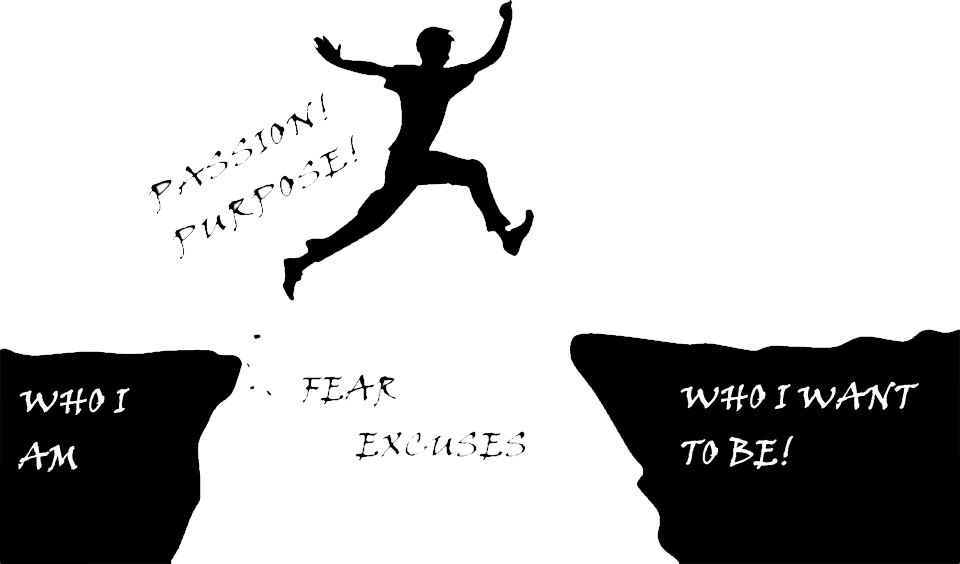
“When your passion and purpose is greater than your fears and excuses, you will find a way.” –Unknown

Ever have something that you really wanted to do?  May be it was a martial art and you were willing to be an awkward novice until you could one day become a graceful master.  Perchance it was a musical instrument where you were prepared to play some sour notes on the way to being able produce a tune that moved people’s souls.  Whatever it was is not important.  The point is that you were willing to be imperfect or even poor at doing something knowing that you would someday become better at it.  You followed your passion and did not stop the first time that you stumbled or struggled to make progress.  Your passion and purpose were greater than your fears and excuses.

Why then do we forget this in so many of our important daily endeavours?  For example, we start exercising and eating better to lose weight.  We are gaining control over ourselves and our behaviours with food and activity.  We want fitness and health.  Then something happens and we are not progressing like we expected.  We are angry at our bodies and ourselves.  We start looking for excuses to quit.   How about when start a new business or attempt a new enterprise in our lobs or careers?  We seem to follow this same pattern and recipe for disappointment.

Many of us seem to suffer attention deficit syndrome when it comes to patiently working towards our goals.  I’ve seen it time and time again in myself and in others. We lose our passion, or worse, we start off dispassionately.  We start something because it is logical and because it seems to be the correct thing to do.  We think that this will be reason enough to keep doing it.  We leave our hearts at the door and expect the mind and body to do all the work.  We are then perplexed when our emotions rise up in protest at being forced into a corner.

You may not need passion to succeed at keeping your teeth clean but I doubt that you will encounter many disappointments or setbacks on the way to grabbing your toothbrush.  The bigger goals in life like health, lifestyle, career, family and such are fraught with discouraging situations and obstacles.  We need our passions to work with us when life throws us curve balls.  I encourage the creation of good habits and routines to minimize our efforts and to lessen our reliance on motivation.  However, when our fears come calling there is only one weapon that can help us overcome them and that is our purpose and our zeal.

With any significant goals there come equally significant fears.  There are great fears of failure, loss, the unknown and change. These fears must be balanced and the opposite of fear is not bravery.  It’s love or passion or zeal.  Fear and anxiety always drive us away from something.  Love and passion always draw us towards something.  Passion and purpose move us to find ways to overcome our fears and obstacles.  It is up to each of us to find our own purpose and drive; otherwise our fears will inevitably sabotage our goals.

So you have set some lofty goals and now the rubber has hit the road.  You have taken action to make your desires into reality.  If this is truly your passion then you have counted the cost and you have already anticipated that difficulty and fear will stand in your way.  Your resolve will be unbending.  Though the path may not be as straight and easy going as you’d like nonetheless you will continue until you have mastered yourself and your objective!  If your heart is not attuned to this quest then the eventual troubles will inevitably derail you.  A person divided within themself cannot stand when opposition occurs; this is a basic principle of combat.  Both your mind and heart need to align for success.

Find your passion!  Find a reason to get out of bed every day beyond the mere need for survival.  You were created to thrive, not to simply survive!  Find the one real thing that makes you feel alive.  Dig deep!  Beware, this may take some time and effort, trial and error.  You may think that you have found an objective or drive only to find that it has waned or changed.  That is okay.  Be patient and keep seeking! Do not be discouraged.  This is a prize worth finding! Success can hinge on your efforts. 

After you have discovered your true passion then everything else can be built upon it: health, family, friends, fame and fortune.  Why should I be fit?  Because your purpose requires it!  Why should I be financially prosperous?  Because that serves your passion! You will know that you have found your passion when a day spent serving it will feel successful no matter the cost and effort and any day that passes without furthering your cause will feel empty no matter how you otherwise benefitted. Once you know your passion and purpose then you will find a way past all your fears and excuses and that way will lead to success!

©2017 S.D. Wilson


Friday, 26 May 2017

Critics for Breakfast

Critics for Breakfast

 “There is only one way to avoid criticism, do nothing, say nothing and be nothing.” –Aristotle
Criticism, it comes from many sources:  friends, family, strangers and even ourselves.  Rarely a day goes by where I do not see posts on here where someone has not been stung in some way by a judgmental thought.  Noble Aristotle makes a very wise point here.  We seem to face criticism for what we do, what we say, what think and what we are.   So we can avoid criticism.  We can largely avoid the slings and arrows of our fellow man and woman: do nothing, say nothing and be nothing. They can’t critique a target that isn’t there.

Or we can accept that there is a cost to becoming something more than we are today.  We can acknowledge that there will always be a source of disparaging thoughts and comments that will be sent in our way as long as we strive for to be better.  We can understand that everyone who advanced was met with detractors and naysayers.  We can know in our hearts and our spirits that mere negative words will be part of the price that we gladly pay to become far more than nothing! Then turn the negatives around with your resolve. Let their “No, you can’t.” be the fuel for your “Oh yes, I can!”

Here’s to a day filled with our potential, bring on the critics…I’m hungry!


©2017 S.D. Wilson


Friday, 11 November 2016

Letter to a Fearful Warrior

Image result for reluctant warrior
Letter to a Fearful Warrior

Dear Warrior,

The end of this life is inescapable. Death comes to everyone without exception. So how you fill the time between death and birth is the only matter of importance. What have you to fear? What are you afraid to lose? Can you really fail?

Feel the brevity of life. Yet do not despair. Rejoice! Allow the urgency of it to infuse your decisions and actions. A warrior who hesitates in battle suffers defeat or worse. Truly, tomorrow never comes so make the best of all that you are and all that you have NOW.

A blade remains useless in the scabbard. A sharp mind remains useless sheathed with inaction. Be a person of action. Overcome the paralysis of fear and uncertainty. Turn and face the enemy knowing who you are. With stillness inside, move rapidly and with purpose. Yield and overcome.

Again warrior, what do you fear? In the end all is lost when the ultimate gift is returned to the giver. In this sense nothing is truly yours to begin with, including your own life. Until the time of your end you must continue to overcome the enemies on your path. They are fear, knowledge and power. Fear blocks your path to knowledge. Knowledge unapplied becomes and addiction that blocks your way to power. Power intoxicates and blocks your way to overcoming yourself.

What is timidity to one who knows that death is his lifetime companion and that each moment may be their last? The past is gone and all it can offer you are its lessons and the wisdom that arises from refection upon it. There is no future, there is simply now. Do what needs doing now. Remember the wise words of Don Juan Matus:

A warrior must focus his attention on the link between
himself and his death. Without remorse or sadness or worrying, he
must focus his attention on the fact that he does not have time and
let his acts flow accordingly. He must let each of his acts be his
last battle on earth. Only under those conditions will his acts
have their rightful power. Otherwise they will be, for as long as
he lives, the acts of a fool.
When one has nothing to lose, one becomes courageous.
We are timid only when there is something we can still cling to.

Today and this moment are yours. Be the warrior that you were meant to be, not an ignorant commoner paralyzed by fear and mortality. Live knowing that death is at hand for any one of us. Love with all your heart. Act without hesitation, knowing the shortness of life. Overcome your enemies. Follow the path with heart, the path with passion. Become impeccable in thought, word and action. You truly have nothing to lose and you have everything to win!

©2016 S.D. Wilson

Tuesday, 13 September 2016

They Are All Broken


They Are All Broken

By Scott D. Wilson

Have you ever been betrayed or let down by someone that you had believed in or trusted?  Have you found yourself questioning the behaviour of someone that you thought that you knew?  I will share something with you that has taken me over forty years to fully realize:  They are all broken.  Every single person out there is broken, including you and including me.  We just don’t see the brokenness all the time because most have learned to hide it well… from others… and from themselves.

I have prided myself in the past by giving everyone the benefit of the doubt.  I used to say that I started all people at one-hundred percent and that they worked themselves down from that.  I thought this was the best way to look at others.  Now I realize that it was terribly unfair.  It always set me up for disappointment.  It placed unrealistic expectations on my fellow travellers in this world.

Believing the best in others means looking at them but not seeing them.  It is like looking for flawless diamonds with a dirty magnifying glass.  Imperfections are smudged and hidden.  As individuals, we have been taught to show our best sides.  Eventually, we will have to clean our lenses.  Inevitably, we see the darker side to someone.  They fail to live up to the image that we have constructed of them.  They naturally act out of fear or insecurity.  They act out of character, and we feel cheated or misled.

Yet you see, the problem is truly not with them but with us.  We are mad with ourselves for failing to see them accurately or properly.  We forgot that they are all broken like us.  One might wisely ask why I say that ‘they’ are a broken if in fact we all suffer the same affliction.  Should the statement not be that ‘we’ are all broken?  Yes, this is true, but not so when make the observation.  For we are not thinking in terms of our own sins and evil when we with judging eyes see the brokenness of those around us.  There is no ‘we.’  There is only ourselves and them.

We all lie to one extent or another.  If we are honest in our observations we will come to realize that we lie to ourselves far more than we lie to others.  We paint over our own imperfections.  We try to see ourselves in the best light.  We soothe our egos by favorably comparing ourselves with others.  In short, we do not see ourselves as broken.  So it is when we are betrayed or disappointed that we plainly see the failings in those who we had painted with our ideals.  We do not sympathize or empathize with their plight. We judge them.

We have disconnected from our own brokenness and become harsh. We feel victimized and wonder why they won't treat us as we treat them. If we want to correct this we first must remember that they are all broken.  Life has made people damaged goods.  We need to expect that they will operate from that brokenness, and enjoy surprise when they choose to be better.  We then must turn inwards and acknowledge our own broken state so that we can let go of judgement, bitterness and resentment. Here we can ultimately remember that we are all broken.    

I am not making this observation to be pessimistic or cynical.  I have come to this realization through hard experience.  It is not optimistic to deceive ourselves about the fallen state of our friends and family.  It is not realistic to ignore our own flaws and shortcomings.  If we see that each one of us has some chips on their heart or cracks in their mind then we can treat those people with kind understanding. When necessary, we can take proper actions to protect and prepare ourselves from the broken actions of others rather than becoming victimized. If we can be gentle with our own faults then we can extend that gentleness towards those around us.  

When next you are disappointed by friend or family do your best to stop and remember that they are broken.  You are the one who expected too much.  Remember the cracks in your own spirit and the bruises on your own soul.  You too are broken.  The only way to help mend such damage is to handle each other softly.  For it is when all the broken pieces are gathered and gently reassembled that true wholeness is achieved.  

P.S.  I am not implying that it is wrong to see the potential and good in others. If we did not see such light then we would soon be mired in cynicism and disenchantment. As the Desiderata wisely states “many persons strive for high ideals; and everywhere life is full of heroism.”

The harm to us comes from our expectations that others, especially those closest, will always operate ideally. First, we cut ourselves no slack and then we do likewise to others.

“They are all broken.” is to be used to remind ourselves that we are judging unfairly. It is my mirror to myself that tells me that I am expecting ideals in a less than ideal world.


Friday, 20 November 2015

Decide! The Deadly Culture of Indecision

Decide! The Deadly Culture of Indecision
©2015 Scott D. Wilson, P.Eng.


“Only when a decision is made and a commitment to action occurs does any real change ever happen.” –SDW

The successful lead. That is a given fact. One phrase often associated with leadership is "a man of action." There is good rean for this association. Good leaders do not waffle or wait to seek consensus. When a faced with a choice they decide and then take action to follow through. That is how they get results. Success is about getting results. Indecision is crippling to leadership.

We are living in a culture of indecision.  We think that making no decision is safer than making the wrong one.  That is a deadly mistake.  Making the correct decision yields good results and we move on.  Making an incorrect decision yields poor results and we face the opportunity to change course and improve. Making no decision yields something and if that thing is good we try to take credit and if it is poor we hold on to deniability because we didn’t make the decision.  This is the mindset of a victim, not a victor. It is certainly not leadership nor is it conducive to any form of success.  Making no decision is actually making the decision not to decide and that can be deadly.

Imagine if an emergency room physician used such a mindset.  Patients would quickly start dying.  Fear of the wrong decision is not an option.  The doctor must choose and work with the results.  If we are to grow and improve then we face the same scenario.  Fear of the wrong choice is no excuse for not making a decision when one is required.  Indecision denies our power.  Indecision doubts our talents and abilities. Indecision withdraws. Only a decision and the commitment to act on it advances forward.

There is a Zen proverb that goes “When you sit, sit. When you stand, stand. Above all, don't wobble.” In martial arts we call this wobbling state being ‘double-weighted.’  A fighter who is double-weighted is vulnerable because their indecision in the face of an opponent has placed them in an unbalanced condition.  If their weight was on one leg or the other then they could seek to advance or withdraw, attack or defend.  In the double-weighted state they are prone to attack and vulnerable to being toppled.  Our poor fighter needs to decide and act in order to correct his situation. Decision must be linked with the commitment to act for it to be effective. An empty decision is no better than indecision.

Is life advancing on you like an opponent and demanding a decision?  Are there areas of your journey were you are faced with a choice on the path?  Do not let indecision rob you of your victory or stop you dead.  In life’s voyage, sitting down at the cross-roads is not truly an option.  Recognize the need for a choice. Believe in yourself and your wisdom to choose.  Make the decision.  Commit to action. Move forward and grow from the experience.

Know that you are the only one stopping yourself.

Monday, 2 November 2015

Know who you are!

Know who you are!

©2015 Scott D. Wilson

High on the side of Mount Parnassus sits the Temple of Apollo and Oracle of Delphi.  Prominently inscribed on the temple walls are the many Delphic maxim.  Among the most famous of these proverbs by far is this one:

γνῶθι σεαυτόν

In ancient Greek it reads "Gnothi seauton" which translates simply to "Know thyself."  Great philosophers and thinkers through the ages have pondered and expounded upon this aphorism.  It seems like such a trite statement: Know yourself.  I mean honestly, we spend twenty-four hours a day with ourselves from cradle to grave.  One would think that we would get to know ourselves pretty well during that time so why bother advising us all to do so?  Surprising, I do think this is often the case.  It has been my experience that we do not tend to pay attention to the commonplace things in our lives.

Unless we come to the point that we are gasping for breath we rarely pay attention to the air that surrounds us.  Until we have been significantly deprived of nourishment then we seldom truly relish the complete experience of food.  It is only when we lose someone significant that we start to understand the depth and breadth of their impact within all the parts of our lives.  So I purport that we humans have a tendency to take ourselves for granted and that we do not truly understand our own hearts and minds very well.  Oh sure, we all carry around an image of ourselves within us but we are constantly amazed when that image is challenged by our own actions and reactions.  We are quite often our own worst enemies and so many of us are perplexed by this fact.

The great Chinese general and strategist, Sun Tzu well understood this important reality of our situation:

“If you know the enemy and know yourself, you need not fear the result of a hundred battles. If you know yourself but not the enemy, for every victory gained you will also suffer a defeat. If you know neither the enemy nor yourself, you will succumb in every battle”

In our daily situation the enemy and our self are one and the same thing.  It is no wonder that we struggle so often with ourselves and with others.  Clearly, it is much to our advantage to overcome ourselves and thereby succeed in our lives.  To do this we need to truly understand and know ourselves. This is not an easy goal.  Since we drew breath we have been told who we are by others and we have likewise formed our own opinions over time.  We have great investment in these personas and identities.  We like to believe ourselves kind, generous or wise.  We enjoy such labels as being ‘a good father’, ‘a great friend’ or ‘a considerate lover.’  We have unquestionably accepted many titles on our journey through life, both complimentary and degrading.  And when our behaviour does not match a hard-held belief about ourselves then we experience confusion and frustration.

So we are thus confronted with the ancient adage to know ourselves.  To follow this directive takes action.   We must sincerely make the effort and take the time to get to know ourselves.  One needs sober and honest reflection on one’s own actions and reactions.  We are required to put aside the images that we have of ourselves and the identities that others have given to us.  Only then we can truly and honestly ask ourselves who and what we are.

I challenge you to reflect upon your life so far and the actions that you have taken.  Have you been cruel?  Have you been kind?  Were you thrifty or wasteful?  Gentle or harsh?  Look at your emotions and your thoughts.  Seek to be objective.  Neither defend nor criticize yourself.  Above all, try your utmost to be brutally honest but gentle with yourself.  In all likelihood what you learn will both amaze and terrify you.  You will need to gently accept your faults and humbly accept your virtues for both of these aspects define you in all your uniqueness.  You are both saint and sinner, light and dark.  This is okay.

Many reading here must wonder about the payoff of such efforts.  Self-reflection is often painful when we face dark truths about ourselves.  It can also be rewarding as we take inventory of virtues that we have been denying.  Above all, I believe that learning about ourselves helps us to become more effective and successful in our daily efforts.  We interact better with others when we understand who we truly are and who we are not.

From my own experience, I list here below but a few of the many benefits of following the sage advice to “Know thyself”:

  • You are equally immune to flattery and insult.
  • You accept yourself and in so doing accept all others as they are.
  • You become invulnerable to coercion and corruption because you know what you need and why you need it.
  • You see that your worst fears guard the pathways to your most passionate dreams.
  • You realize that peace, love and happiness are not destinations.  They are the pathway.
  • You understand your connection with your environment and source for all life.
  • You develop the awareness that you cannot give without receiving or take without losing. 
  • You know that hatred gives energy to the things that you hate and so you selfishly conserve your energy and forgive.
  • You see the difference between knowledge and wisdom… and choose wisdom.
  • You lose the words I’ll try, I think, I hope and I might.
  • You use the words I will, I can, I have, I am, and I shall.
  • You see with clarity your own folly, flaws, errors and failures and face them without excuse or self-pity.
  • You acknowledge and accept the darkness within your own soul.
  • Knowing your own short-comings and imperfections you extend gentleness, kindness and love towards the harsh cruelty, fear and selfishness of others.
  • Humbly you accept your talents, gifts and virtues and take responsibility to act on them.
  • You become free to love abundantly without restraint or conditions.
  • Looking outwards you see this world with new eyes.  Nothing changes and yet everything does!

And lastly, you will be able to follow the last directives written at the Oracle of Delphi…

    Παις ων κοσμιος ισθι – As a child be well-behaved
    Ηβων εγκρατης  – As a youth be self-disciplined
    Μεσος δικαιος  – As of middle-age be just
    Πρεσβυτης ευλογος  – As an old man be sensible
    Τελευτων αλυπος  – On reaching the end be without sorrow

Wednesday, 5 August 2015

A Flash of No-Regret

A Flash of No-Regret
©2015 Scott D. Wilson,P.Eng.

Despite the best of intentions through most of our life, most of us carry some regret. Today, I was given an incredible gift. Before I simply blurt it out I should offer some context.

From Friday evening until Saturday's setting sun is my time of rest. I do my best to spend this time with family and friends in rest, recreation and leisure. Sure, I putter around the house doing chores and repairs but these are labours of love, not my livelihood.

And so today I was chatting with my two adult children and watching old music videos from the 80's. It was during one such video that I was transported back briefly and for one flickering moment I was 17 year-old Scott. I wore his clothes, his shoes, his hair. I saw the choices of his life before him. I saw the beauty by his side who would one day become his bride. And then in a brief moment I rushed forward through my life until I was back sitting in my kitchen with my kids.

In that short ephemeral vision I passed through all my choices in life. I saw my victories, my defeats, my successes and my failures. I experienced all my choices again - both the 'good' and the 'bad'. And I realized that all my actions brought me to this simple time of pleasure with my eldest son and daughter. Right now, everything is pretty well ok. So how could and of those choices been all that bad?

In that instant I had great empathy for all those Scotts of the past. I saw the choices they made with the knowledge, wisdom and experience that life had afforded them. They were good men doing their best with what they had. I do not know if words can convey the love and compassion that I was suddenly able to feel towards my past selves.  I understood how foolish it was to regret past 'mistakes' or 'poor' choices. To change those choices would lead to a now that I might believe would have been better but truth be told, it could easily have been far worse. Perchance the choices that would have made me rich back then would have left me miserable now. Who is to say?

We do not know now how the choices we make today will play out. We seek actions to bring about the best consequences but nothing is guaranteed. Soren Kierkegaard once said "Life can only be understood backwards; but it must be lived forwards."  It is with understanding that we must release regret.

Regret only robs our present moments of joy and peace. Regret has no value in helping us to move forward towards our goals. Regret makes us harshly judge our past choices and it paralyzes our present ones. If you are one who struggles with regrets then realize today how futile it is. Your past 'errors' may be responsible for some of the best things in your present. Have compassion for your past selves. Forgive them. And with that in your heart and mind root yourself here and now and bravely face the future that your next choices will create!!

Sunday, 12 July 2015

The Other Small Voice


The Other Small Voice
©2014 Scott Wilson
I have a guest writer here today who wanted to speak their mind...

Hello, can you hear me? I am the OSV, the Other Small Voice. You probably don’t know me too well but that’s ok. Most people ignore me or they listen to my brother NSSV, the Not So Small Voice. He’s the guy who’s always telling you that you aren’t good enough, smart enough, lucky enough or even deserving of anything good.
 
He’s seems to be far more successful than I am because almost everybody seems to listen to him. Maybe it’s because he reminds people that they are just the same as everyone else and he comforts people when they fail by helping them to come up with good excuses. Also, he saves people time and energy by using these same excuses to avoid attempting anything worthwhile.
 
But enough about him, it’s my job to remind you of the miraculous nature of who you are and the virtually infinite potential that you possess at this very moment. Did you know that your personal DNA contains a unique sequence of over 3.2 billion base pairs? Barring cloning, there will never be another human being with your specific DNA sequence. Never. You are quite literally an amazing scientific and biological masterpiece. One might even say, a miracle.
 
I’m telling you this because you need to understand that you have a unique opportunity at this time and this place. Some things you have no control over, like the weather and where you born. The list of uncontrollable things is indeed vast. But you have one very powerful tool: choice. In this moment you have control over what you choose to do, to think and to be. That is powerful! That is far more powerful than the things that you cannot control.
 
You can choose to follow others or you can chart your own course. The point is – this moment, and the next one, will be what YOU choose to make them. You can coast along on autopilot doing what is easiest and accepting what this world seems to be – for better or for worse. Or you can question and dream and start to build something else, something different… something better. Will it be easy? Not likely. Will there be a cost. Sure. Will it be worth it? Oh yes!
 
Once men looked up and dreamt of flying and now thousands of people are in the air as you read this. Dreams can become reality when you have a vision and make the choice to follow it. So that is why I am here.
 
I am the Other Small Voice. I know that you have been listening to Not So Small Voice… but he is wrong!! Today I want you to take a chance, dream a dream, and make at least one small step towards a better tomorrow for yourself and everyone. You deserve it. This world deserves it. If everyone on earth took one step closer to their dream today image how amazing tomorrow would look?
 
You are unique!
Your time is NOW!
Make the best of it!
The choice is yours…
 

Thursday, 9 July 2015

Going Dry


Going Dry

©Scott D. Wilson, P.Eng. 2015
 
Writer ’s block, losing your muse, loss of inspiration are just a few terms for what happens when innovative people hit the metaphorical wall in their running quest for creativity.  This process seems to happen to every artist, inventor or innovator.  I can tell you that it is a difficult state for those whose spirit is driven to bring forth new creations and ideas.  It is very much like the soul lost in the desert thirsting for water.
 
Perhaps a metaphor might help to explain.  I have found that the creative process is very much akin to the physical procreative process.  Ideas seem to be inseminated within our minds during the loving exercise of our passions.  Once planted a creative vision is wrestled with as it grows and takes on a life of its own within you.  Just like pregnancy, it is an uncomfortable time as the new dream kicks and challenges the old ideas.  Your mind’s horizons are stretched and grow as the notion wrestles with past thoughts and experiences.
 
And then one day the urgency of the idea becomes intense and the near frenzied birth process takes place as the concept demands attention and action in becoming something physical: a story, a poem, a song, a picture, an invention, a business plan, a recipe, a…  And just like a proud parent you cautiously take your creation out to show to others hoping that they too will see its beauty.
It should be evident that this process can stall at many of the stages along the way but the one that troubles most folks is the inspiration at the very beginning.  Novel and interesting ideas seem to dry up and blow away.  Everything seems old.  The creative individual is left struggling and wondering why their source of inspiration has dried up.  From my own experience this state occurs progressively and results from one thing:  living an uninspiring life. 
 
This may sound overly simplistic but believe me that my statement is quite vast in its implications.  Most do not realize that their ideas are born of their daily life experiences.  Thanks to our hippocampus we only consciously perceive a small percentage of what our senses bring into us on a daily basis.  If this were not the case then we would be inundated by all the tastes, smells, colours, sounds and sensations.   Nonetheless, as we live and experience our days with all their sensations, emotions and thinking we gain experience that is stored and generates our thoughts, ideas and dreams.  Most scientists presently believe that our dreams are a way of our minds processing all that we have perceived, consciously and unconsciously during our day. 
 
In essence, our minds digest the experiences that we put into them every day and turn them into understanding and ideas.  In other words, the mind eats life experience like the body eats food.  Our minds grow strong and our wits sharpen when we provide them with stimulating events and ideas.  Unfortunately, we often allow life to become too routine or mundane and we lose our appreciation for the miracle of our own particular existence.  The common yet mundane entertainment and distractions of life rob our minds of the experiences that they crave.  This often happens through the natural survival processes of our usual days.  I have a few suggestions to correct this matter.
 
My first proposal:  Meditation.  Now before you roll your eyes and tell me that meditation is not for you I need you to revisit the concept of meditation.  When most hear the term mediation they envision guru’s seated on mats with their eyes closed for hours in silent contemplation.   This stereotype is a rather myopic view of mediation.  Mediation has many forms both static and active.  A popular active form of meditation is the Chinese martial art and activity Tai Chi Chuan.  However, others find mediation in a quiet walk with one’s pet or jogging with classic music.  My point is that each one of us can find a form of mediation that works for us.  I encourage you to find yours, anything to free your mind from the day’s mundane thoughts.
 
My next recommendation:  Reconnection with God or the Universe.  Knowing who we are and our purpose plays a strong role in bringing inspiration to our lives.  Similar to mediation, some find prayer to be a conduit for connecting to their spiritual side.  This connection can however take many forms.  Many find understanding of their identity through study and their family, cultural roots or their past.   Our lives were meant to be lived but they were also meant to be reflected upon to be understood and given meaning.  The ancient Greek philosopher Socrates put it this way “The unexamined life is not worth living.”  Whether practical or spiritual, many find that journaling or writing a diary helps them to connect with themselves.  Again, I urge the reader to find their own particular habitual connection.
 
Another suggestion:  Follow a passion or a hobby.  This may seem trite but it is a serious statement.  Many popular teachers today encourage us to find our passion, as if this is a singular thing.  However, many successful people pursue multiple interests and enjoy a variety of hobbies.  Our interests help us to relax and encourage us in our creativity.  Baking a cake or brewing beer may seem completely unrelated to writing or playing an instrument but many attest that following seemingly commonplace activities quiet minds and stir creative juices.  Often our hobbies can become forms of active meditation.  Likewise, following our various interests can also lead to better understanding of ourselves and our purpose.
 
Finally, I recommend:  Associate with other creative people.   There are several reasons why like-minded people form clubs and associations.  Certainly, one of the most significant reasons is to share information and ideas about their work and interests.  Creative people tend to brainstorm ideas with others who share their passions. If your well has run dry then it is a good idea to look around and fins some groups of people who are pursuing your craft.  The internet is filled with coaches, clubs, associations, mastermind groups and the like.  The point is, join one or more such groups and participate in their forums and real-life gatherings.  Write and chat with these people.  Help others to get started.  Whether giving or receiving help and advice you will learn and benefit.  Proverbs 27:17 of the Bible puts it well: “As iron sharpens iron, so one person sharpens another.”
 
Those four related suggestions form my recommended oasis for those thirsting for their muse or spark of creativity.  I am sure that other venues exist and I encourage you to try them all.  As in other areas of our life we need not feel like victims when our ideas become sparse.  We can be empowered to re-establish our own imaginations and rekindle the fires of inspiration in our lives.  It is not hard to lead an inspiring life but it does take effort and intention at times.  We have only ourselves and our own misgivings preventing us from regaining what we may feel that we have lost.  Let nothing stand between you and your muse!  I tend to agree with author and speaker Jacob Nordby when he stated:

“Writer's block is just another name for fear.”

On a parting note, if you want to hear an inspiring story from a modern artist who lost and found his muse I highly recommend Sting’s powerful TED Talk entitled “How I started writing songs again”:
https://www.ted.com/talks/sting_how_i_started_writing_songs_again?language=en
 

Tuesday, 7 October 2014

Letting go of Right


Letting go of Right

©Scott D. Wilson 2014

We all want to be right.  It is natural.  Our primary reason for wanting to be right is because we logically assume that if we are not right then we must be wrong.  We believe that there exists a single unchallengeable objective truth; all other views are therefore wrong and false.  Sadly, this is an error and it is one that causes a lot of grief.  The closest way that I can illustrate this fallacy is with colour.


It is illogical to assume that if something is not white then it must be black.  Just as right and wrong are logical extremes so too are black and white.  White the is actually a mix of all visible light colours while black is the absence of all these same colours.   So it is with right and wrong.  Rarely are we as humans discussing things that are truly cut and dry.  We may think that things are either black or white but that is rarely so.  Just as white light is made up of the various primary colours so too can right have different aspects as well.


By this analogy one could not argue that red is more white than say yellow.  Both colours are equally elements of white light.  The same thing frequently holds true when we argue over what is right and wrong.  More often than not we are usually debating the difference between one element of right and another one.  We are, in effect, discussing red and yellow and arguing that one is more white than the other.  We do this at our own loss; for in so doing we frequently lose the opportunity to learn something about ourselves and our opponent.


Because of the many facets of truth it is impossible for any one person to obtain a monopoly on truth.  As illustrated with the analogy of colour, truth has many facets.  What can make right and wrong, truth and error even more tricky is the fact that many truths exist within paradox.  I am an electrical engineer so I will choose a physical paradox to illustrate this one: light.


Depending on how you choose to observe it light acts either as a particle or a wave.  That fact is paradoxical because particle and wave models cannot be reconciled to each other. The truth is that we truly do not know what this means in regards to light.  The best physics can come up with is that light exists in an undetermined wave/particle state until we try to observe it.  So saying that light is a particle is equally true and false, right and wrong.  It is likewise in regards to light as wave.  Once again, our premise that there must be one correct view and all others views are wrong is proven in error here.


As I stated before, our need to be correct is strong and natural.  No one wants to be in error.  The light paradox should alert us to the fact that often truths are personal based on the observer.  What is right for me may not necessarily be right for you.  Each of us has an obligation to test the validity of things and ideas for ourselves.  We cannot have others do this for us by proxy.  Our experience and view is unique to us and to us alone.


For example, I have a relationship and view of my eldest sister that will in some ways be in complete contradiction to that of her husband, her children or my mother.  My truths about her will only work in the context of our unique relationship as brother and sister.  Those views will no longer be entirely right from someone else’s standpoint.  My sister and I will be confident in those truths between us; we do not need to be right in the eyes of other people.  It therefore becomes important to understand that what is true for us may not be true for others.  Likewise, what may be true in some context is not true in all circumstances.


Confidence in our own truths is another thing which aids us in letting go of right.  If you are truly confident that you are right then you should not feel an obligation to prove it to everyone else.  The need to convince others of our correctness often springs from a lack of conviction on our part.  If what you believe is true then you should be confident that eventually that truth will be revealed to others without the need for your to convince them.  This shows confidence in the nature of our truth.  We need to allow others to find the truth for themselves because in the end it is not right to seek to control them nor to rob them of responsibility for their own lives.


Fear of being wrong is unhealthy and can actually blind us to the truth.  We often invest much time and effort based on what we deem to be right.  This investment can make us biased.  The scholars who worked hard making mathematical models of the solar system with earth at the centre were  hardly open to ideas that Galileo presented.  A sun-centred model meant they had wasted much of their careers.  We all naturally react this way.  In this case, the scholars’ models were wrong and Galileo was right.  Had the scholars been brave enough to consider themselves capable of error then they might have seen the truth in Galileo’s observations.  Do not let fear of error blind you.


My last point in favour of abandoning the need to be right comes from Dale Carnegie in his book “How to Win Friends and Influence People.”  In it he writes:


“You can't win an argument. You can't because if you lose it, you lose it; and if you win it, you lose it.”


The statement may seem to contradict itself but it does not.  We cannot win an argument with someone without making them feel diminished and inferior.  The person’s ego will rebel and it is unlikely the person will be truly convinced of your truth.


There is a psychology experiment where an unfocused image is projected on a wall and the participants in the experiment are asked to guess what the image may be.  In one scenario the participants’ beliefs are challenged and in the control group no comment is given on the person’s guess.  The image is slowly brought into focus and the participants are either challenged or merely questioned on their guess.  The results of the test are remarkable.


Those who were only continually asked what they saw were eventually able to see the actual image when it was brought into focus regardless of what they initially guessed about the image.  However, those who had their guesses challenged became more and more entrenched in their view and often continued to argue their guess even after the image was brought into complete focus.  Some participants could not actually admit when their guess had been completely incorrect.  The experiment showed that the act of arguing itself had actually reinforced the initial views of the parties even when the final outcome had concretely disproven their initial beliefs.  


So even when we win at being right, we lose.  In our efforts to be right we can actually make it harder for others to see the truth that may be plainly before them.  Just like our muscles, beliefs tend to grow stronger under resistance.  This is a counter-intuitive truth.   A better approach in such conflicts is not to nay say but rather inject “Yes and…”  Agree with their truth and present your own views.  By agreeing first we prevent the resistance that will sabotage an open discourse.


In conclusion, it would seem that our need to be right in the eyes of others usually has destructive consequences for ourselves and others.  Truth needs to be seen in context and we need to appreciate that our own truth may not completely translate to the point of view of others.  We need to seek truth and understanding for ourselves and allow others the freedom to do likewise without undue influence.  We should not fear error, but remain open to correction.   Respect the views of others and instead of tearing away at their understanding offer instead your truth to stand beside theirs as an equal.


Letting go of right can go a long way towards peace in ourselves and with others.  We still must find what is right and correct for ourselves.  However, speak your truth quietly and you will find that your influence will extend much further than it ever would by winning some debate.

Tuesday, 9 September 2014

Sticky Problems!

Sticky Problems!

©Scott D. Wilson 2014


Whether you are an illustrious business tycoon or a lowly street sweeper life is full of trials and problems.  Married or single, rich or poor, famous or obscure, the process of living presents us daily with challenges that we need to face.  Author and speaker Helen Keller once so eloquently put it:


“The struggle of life is one of our greatest blessings. It makes us patient, sensitive, and Godlike. It teaches us that although the world is full of suffering, it is also full of the overcoming of it.”


Troubles are a universal part of the human condition and will continue to be so for as long as we exist.  Many make it their goal in life to avoid as many problems as possible but that is futile. It is far wiser to learn how to better handle the challenges that befall us.  I work as an engineer.  Engineers are often viewed as professional problem-solvers because they tend to have a knack for developing solutions to physical problems.  One thing I have learned is that how you look at a difficulty has the greatest effect on your ability to discover a solution to it.


I once took a driving course called "Skid School" where they purposefully put us in vehicles and caused them to skid and spin.  Our job was to skillfully apply what they taught us in the classroom to recover from the skids, regain control of the car and avoid hitting objects on the road.  The most valuable lesson that I learned from this experience was simply this:  We tend to hit the thing that we look at.


In driving, the instructors emphasized that many people unintentionally get stuck staring at an unexpected object that enters their driving path. The people then unfortunately tend to hit these random distractions.  During one lesson we drove a car down a slippery road and an instructor would move an object from either the left or right side and we had to avoid it even when the vehicle started to skid.


It is so instinctive for us to focus on the problem when it appears.  Many in the class saw the object in their path and despite carefully braking they were helpless to avoid colliding with it because they kept their attention on the obstacle.  The instructors explained that to avoid the problem the driver needed to look beyond it towards the destination that the wanted to go.  When we learned to look down the road we could readily avoid the obstacles that suddenly appeared on the path even though our cars were on slippery roads and began to skid.


In the final lesson the instructors sent the cars into a rear wheel skid with the car viciously spinning in circles.  The students had to recover control of the vehicle and keep the cars on the road and going in the original direction.  Again, to do this the drivers had to maintain focus on the destination, far off down the road that they were travelling.  I learned that day that I could recover from a very dangerous skid as long I kept my eyes on where I wanted to keep the car going.


I offer this long-winded story on safe car driving to illustrate a common flaw in how we often approach less tangible problems in our lives.  When we encounter challenges in life so many of us lose sight of our goals and spend our time looking at the barriers.  This is somewhat instinctive and natural.  Fear draws our attention away from the objective that we seek and desire!


This mistake seems to happen in so many areas of our lives.  In engineering we can get lost trying to fix a technical issue when we might do better looking at developing alternative ways to achieve the same objective.  When looking at our health we tend to get stuck looking at our diseases rather than improving well-being.  With fitness we get mired focusing on our weight and our fat when developing our muscles and overall health would serve us better.

We can plainly see this kind of thinking at work throughout our society.  We have anti-bullying campaigns not inclusivity and empathy programs. There are anti-poverty initiatives but very few prosperity movements.  As good intentioned as they may be, it is my experience that anything with an 'anti' focus tends to exacerbate the undesirable element.  Many bad ideas and thinking unfortunately thrive through resistance rather than diminishing. 


I have discovered that when I let go of the problem and start to focus again on where I want to go that the best ideas to address my present situation arise.  Whether it is my weight, my finances, my personal relationships or my job, I have learned that the fears about my goals become distractions.  My success is surer when moving towards the goal remains the objective rather than avoiding the pitfalls.


So I encourage you today to approach your troubles better.  Let go of your sticky problems.  Look again down the path towards the goals that you want to achieve.  Keep your attention on what moves you forward and not on the things that block your path or have you looking backwards.  Only then will you be able to keep control, steer clear and keep on the road to success!