Search This Blog

Showing posts with label martial arts. Show all posts

Friday, 11 November 2016

Letter to a Fearful Warrior

Image result for reluctant warrior
Letter to a Fearful Warrior

Dear Warrior,

The end of this life is inescapable. Death comes to everyone without exception. So how you fill the time between death and birth is the only matter of importance. What have you to fear? What are you afraid to lose? Can you really fail?

Feel the brevity of life. Yet do not despair. Rejoice! Allow the urgency of it to infuse your decisions and actions. A warrior who hesitates in battle suffers defeat or worse. Truly, tomorrow never comes so make the best of all that you are and all that you have NOW.

A blade remains useless in the scabbard. A sharp mind remains useless sheathed with inaction. Be a person of action. Overcome the paralysis of fear and uncertainty. Turn and face the enemy knowing who you are. With stillness inside, move rapidly and with purpose. Yield and overcome.

Again warrior, what do you fear? In the end all is lost when the ultimate gift is returned to the giver. In this sense nothing is truly yours to begin with, including your own life. Until the time of your end you must continue to overcome the enemies on your path. They are fear, knowledge and power. Fear blocks your path to knowledge. Knowledge unapplied becomes and addiction that blocks your way to power. Power intoxicates and blocks your way to overcoming yourself.

What is timidity to one who knows that death is his lifetime companion and that each moment may be their last? The past is gone and all it can offer you are its lessons and the wisdom that arises from refection upon it. There is no future, there is simply now. Do what needs doing now. Remember the wise words of Don Juan Matus:

A warrior must focus his attention on the link between
himself and his death. Without remorse or sadness or worrying, he
must focus his attention on the fact that he does not have time and
let his acts flow accordingly. He must let each of his acts be his
last battle on earth. Only under those conditions will his acts
have their rightful power. Otherwise they will be, for as long as
he lives, the acts of a fool.
When one has nothing to lose, one becomes courageous.
We are timid only when there is something we can still cling to.

Today and this moment are yours. Be the warrior that you were meant to be, not an ignorant commoner paralyzed by fear and mortality. Live knowing that death is at hand for any one of us. Love with all your heart. Act without hesitation, knowing the shortness of life. Overcome your enemies. Follow the path with heart, the path with passion. Become impeccable in thought, word and action. You truly have nothing to lose and you have everything to win!

©2016 S.D. Wilson

Sunday, 17 July 2016

Finding You Ikigai

Finding Your Ikigai
By Scott D. Wilson

Have you ever struggled to stay motivated towards a given goal?  Whether it was sticking to a financial budget, striving to keep a fitness goal or some other beneficial discipline, you just couldn’t seem to muster what you needed to keep your focus.  You are far from alone.  What if I were to suggest that you are only seeing a symptom of your trouble?  Perhaps there is another element missing from your life that would help to put your goals on track.  Perhaps you need to find your ikigai.

When it comes to health, well-being and longevity the world seems to worship at the feet of Okinawa, Japan.  Their lifestyles have been exhaustively studied.  Many diets and supplements have been created from their way of eating.  Their martial arts and meditation practices have been taught and spread around the word.  Although these are all noble efforts it is the more recent focus on the people’s philosophy and thinking that has caught my attention.

You see, in Okinawa there is not real concept for retirement.  People are simply expected to remain engaged in life throughout their entire lifespan.  Oh for sure, people slow down and they may even change occupation but their life experience is constantly being applied in gainful ways.  Central to this way of life is the concept of ‘ikigai’ (生き甲斐, pronounced icky-guy).  The term ikigai is composed of two Japanese words: iki (生き?), referring to life, and kai (甲斐?), which roughly means "the realisation of what one expects and hopes for".  In short, it is "a reason to get up in the morning" or a reason to enjoy life.  Everyone, according to the Japanese, has an ikigai.

There is a TED Talk by Dan Buettner who suggested ikigai as one of the primary reasons for the longevity of Okinawans, and he may be onto something.  For finding one’s ikigai requires a long and deep search of oneself.  Finding your ikigai is akin to finding the meaning of your life.  Ikigai brings value to one’s life and it set our purpose.  Times may be gloomy and dreary and fortunes may be failing but a person who understands their ikigai presses on with intention and resolve.

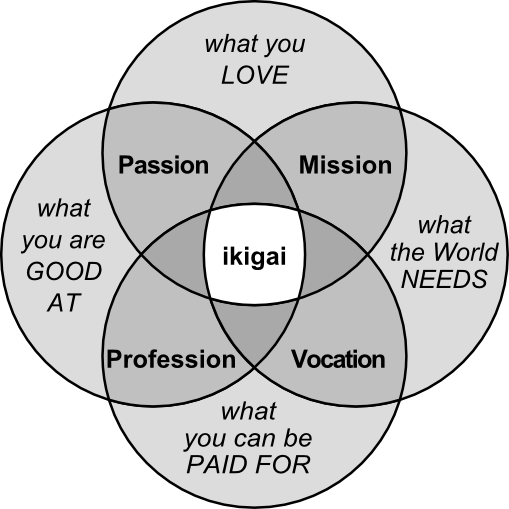
It is generally believed that one’s ikigai can be found at the intersection of four areas of one’s life:

#1 What you love.
#2 What you are good at.
#3 What the world needs.
#4 What you can be paid to do.

Imagine that sweet-spot where you are doing something that you love, you are good at, the world needs and you can be paid to do it!  That is ikigai.  It is that place where your passion, profession, mission and vocation come together.  As I said earlier, it gets you up in the morning.

I want people to succeed.  To this end I study the successful lives of people throughout history.  I seek through the disciplines of philosophy to better see and understand life so that might develop methods to make myself and others more successful and prosperous.  I like the concept of ikigai because it draws together all the elements necessary for our success in any venture.  We like to believe that we are purely rational creatures making decisions based on our noble beliefs and logical understanding.  This is largely bunk.  We are irrational and emotional creatures with a capacity to use reasoning.

We try to remain rational but our emotions make most of the decisions and our reasoning minds tag along for the ride.  If anything, our rational mind and our emotions and spirit are usually at odds with each other.  The rational mind rarely fares well in these conflicts, retreating to a corner and licking its wounds while finding logic to justify our largely illogical choices and decisions.  All too often our minds are slaves to our fears, being made to generate sound reasons for avoiding risk and keeping the status quo intact.  “If it isn’t broken then why fix it?” we intone to justify remaining as we are, regardless of our state of being.

This is not the best way to live life.  This is surviving, not thriving.  Those throughout history who were happiest and healthiest followed their hearts and their dreams.  They used their passions to face their fears.  They were not content to keep what they loved, what they were good at, what they were paid for and what the world needed in separate boxes of their lives.  The successful in life fused these four together to fuel their efforts and generate success in all areas of their lives.  It did not matter if they were striving in school, working through their career, starting a new business, creating art, perfecting their baking, or losing weight; those who succeeded did so with every facet of their being.  They knew largely how to harmonize their emotional and rational minds to resolve the conflict and overcome the inevitable fears that block the path to their success.

We are each a mixture of loves and fears along with experiences and memories. We have been endowed with a marvelous mind that can think, innovate and create.  We can tame our fears and we pursue out loves.  We can give our lives purpose.  This purpose will drive all that we work to achieve.  Yes, ikigai gives us a reason to get up but it also brings meaning to everything that we seek to accomplish.

Without ikigai all our noble efforts will be shaky at best.  Without a core purpose then we will naturally question following any goal.  If we wonder why we are here at this time and place then we will wonder the purpose of doing anything whatsoever.  How can such uncertainty succeed?  In contrast if we have a core purpose fueling our every breath then we will put our entire being into every goal that harmonizes with our ikigai.  If weight loss facilitates our ikigai then we will lose weight.  If prosperity helps us to follow our ikigai then we will strive to prosper. If you have united your passion, your mission, your profession and you vocation then you can use that to succeed in all your dreams and hopes.

And so I commend you to seek your own unique ikigai. Stop fumbling with lesser goals.  There are many who are content with very little.  They shed their quests for fame and fortune and followed a path with heart.  They face their fears daily and overcome them.  Still others prosper that they might fulfill their deeper purpose.  All their goals are full and meaningful because they are tied to their central ikigai.  If you have found your motivations flagging and you are asking a lot of ‘whys’ then that is your opportunity to discover your ikigai.  Follow those ‘whys’ as far as they will take you.  If you can satisfy your own questioning mind and inquisitive heart then an amazing treasure awaits and the Okinawans have named it ‘ikigai.’ 

©2016 S.D. Wilson

Tuesday, 22 December 2015

Anticipate Weakness


Anticipate Weakness


©2015 Scott D. Wilson,P.Eng.


No matter what noble goal we pursue there will come moments of weakness where will we be tempted to throw in the towel or to simply derail our progress by doing something counter-productive.  For the person trying to lose weight it will be that time late at night, fatigued, lonely and down. That will be when the refrigerator or the cookie jar will sing with its irresistible siren song.  For the new entrepreneur it can be around the time that the novelty wears off, enthusiasm peters out and their confidence begins to wane. Or perhaps the feeling of despair sets in when the first significant challenge rears its head and seems insurmountable.   In short, the urges to give in and give up are pretty well universal to all who set goals and set out to succeed.
 

The lesson is that everyone falls prey to moments of weakness so we should anticipate these moments and do our best to prepare for them.  When we set out we always envision ourselves motivated and energized from that point onward.  This is an unrealistic expectation of ourselves.  We need to be kinder to our future selves and help them prepare for the moments of weakness and temptation.  Under present conditions we need to empathize with those under the strain to conform and to take the path of least resistance.  What tools could we give them to help them succeed?  What information could help them to stay positive and motivated to continue?  It is best to ask these questions now when there is no pressure or urgency.
 

If we each had an enemy that we knew was going to attack us some time in the future where we are at our weakest then we would be crazy not to take precautions against them.  We might hire security, train in self-defence, purchase weapons, travel in groups for safety or some other protective measures.  We would certainly not ignore the future threat.  In this case we are actually being pursued by an extremely dangerous enemy and that enemy is ourselves.  We know that they will hit us when we are most vulnerable so it makes sense to prepare now while we are strong.
 

There is another way to understand this idea in concrete terms.  We do our best to maintain our vehicles.  Nonetheless, many of us keep emergency kits in the car so that the effect of unexpected breakdowns is minimized.  Likewise, it is prudent to have disaster kits in our homes for emergencies and first aid.  It would be unwise to start a long quest in the wilderness without a survival pack.  I am suggesting something similar here.  We need to prepare a kind of emergency kit for motivation and determination.  For example, our midnight snacker might pack a distraction in their kit.  They think of food while bored and lonely so the kit might be a game or book or movie or something that they would enjoy more than a snack.  Reserve this item specifically for emergencies so that it is a truly worthwhile distraction.
 

Whether dieting or starting a new business  or any self-improvement goal, the emergency kit will need to be personal and it will need to help keep us in the right direction.  There is no one pat answer that will help for everyone.  Our entrepreneur might write down a list of reasons why they want to pursue their business and keep it in their kit.  Another might list all their talents and assets that support their goal.  Still another might keep recommendations and commendations from various sources that affirm their objectives.  The point is to get creative.  Use pictures, videos, songs, audio, mementos, cash, a list of friends to call, special objects… anything that will shore you up and help you to stay the course when your moments of weakness hit.  The effectiveness of your emergency kit will be proportional to the effort that you put into it while preparing. It also goes somewhat without saying but remember that this is an emergency kit.  It is to be used as weapon of last resort. The more it is used the less effective it will become.  This device is to help you when you are most in need of it.
 

I should also mention that our emergency kit does not necessarily need to be physical.  Martial artists train in repetitive cycles call katas, taolu or forms.  It is this repetition that prepares them to act appropriately when encountering an enemy.  This training and preparation is done when no threats are present.  It allows the people to be prepared and confident when a real opponent strikes.  Since we are talking about mental and emotional battles with ourselves then the fight will be taking place in our mind so it is there where we can also make preparations.  Mottos, maxims, prayers and quotes that reverberate within us can also serve to bolster us when weakness hits.  Again, these are personal so each one of needs to find something that we can repeatedly bring to mind that will help our thoughts, our spirits and our hearts.


My point in this diatribe is to encourage you to anticipate the worst in yourself.  Do not hold unrealistic expectation of your abilities and motivation.  Humbly admit your weaknesses and failings.  We all suffer from self-doubt and loneliness at different times.  Nobody alive is free from temptation.  However, these darkest hours need not be our downfall if we anticipate and prepare for them.  Take the time today while you are in a good place and your goals are clear and certain.  Work and plan to help yourself to remain on course for your goals when the windy trials and tribulations of life seek to shipwreck you and blow you off course! 

Sunday, 23 August 2015

Buddha on a Bike


Buddha on a Bike
©2015 Scott D. Wilson, P.Eng.
 
I am always looking for trends and common threads among successful people. Lately, I have noticed that very many successful people admit to various practices of mediation or mindfulness. The billionaire founder of Bridgewater Associates, Ray Dalio went so far as to say “Meditation more than anything in my life was the biggest ingredient of whatever success I've had.” That is quite an endorsement! There have been countless studies on meditation and here are just a few of positive effects of meditation:
  • Reduction in stress and a better ability to handle stressors
  • Improved brain functions
  • Increased productivity in high performance situations
  • Reduction in the symptoms of anxiety and depression
  • Improved ability to fight disease and to maintain health
  • Better-quality sleep
  • Longer attention span and stronger ability to focus
  • Increased metabolism and assists in weight loss (Yes, weight loss – through the increase in mitochondria!!)
  • Greater level of creativity
These are just a small sampling of the benefits of meditative practices.
Now if you are like me then when you hear the words mindfulness and meditation you suddenly get a vision of a long-haired old hermit with a flowing beard seated at the top of a mountain. The reality is that nothing could be further from the truth. In the 60’s the Beatles introduced eastern transcendental meditation into mainstream western culture. Since then we have tended to focus on the various forms of seated meditation from the ancient Ascetics to Zen monks. Fortunately, seated or static meditation is but one form of mindful exercises.
For me, the thought of sitting for a prolonged period without movement with the aim of clearing my mind and my thoughts is right up there with listening to fingers raking down a chalkboard. I am in no way dissing this means of contemplation. There is a time and a place for such practice and it is better suited for some people and less so for others. If these work for you then I encourage you to continue.
Others like me have been discouraged with many of the transcendental techniques. Fortunately, there are alternatives and I wish to increase awareness of them. Some of you may know that there are techniques known as moving meditation. By far the most popular is the practice of Tai Chi. Many martial arts employ moving meditations. For example, Karate employs various moving exercises called katas. Yes, these routines are a form of practicing the offensive and defensive techniques. They are also excellent forms of moving meditation.
Anyone who has sought to master a Tai Chi form or a martial art kata knows that you start out thinking your way through them and your mind jabbers as it seeks to remember and follow the movements. However, as you become more adept your mind stills as your focus on your arms, legs, breathing and so much more absorbs your entire attention. For folks like me this is a marvelous form of meditation – moving outside and still inside.
“But I don’t like martial arts and Tai Chi just isn’t for me!” you object. Guess what? Martial arts do not have the lock on this form of mindfulness. Ask a marathon runner or any other serious athlete and they will tell you that when they hit their stride that there are moments of peacefulness and stillness as all they hear is their blood pounding and the rhythm of their limbs. Do you have to be a professional athlete? Not from my experience. I have discovered that my meditation often occurs atop the pedals of my bicycle.
Sure, I start out just thinking about my day as I get started pedaling down my driveway. The mind is a persistent beast and it wants to go over all the various concerns of the day ahead. Eventually, as I drive my bike harder either in silence or while listening to music then the thoughts slowly quiet. There is just me and my bike connected to the road, the trees, the grass, the dew, the sunshine and the entire universe.
So am I saying that you must become a Buddha on a bike? No, but you must find an exercise that you can use for at least ten minutes that will afford you some quiet contemplation. I have found such moments of meditation in Tai Chi Chuan, running, biking, skiing, walking quietly and even while washing dishes. The key is to immerse yourself in the activity. Give it your whole attention. When you are performing your activity perform it to your best. Pay attention to details. Pay attention to your movement, to your limbs, to your breath, to your heartbeat, to you surroundings (smells, sights, physical sensations, noises and even tastes). If possible, don’t linger on one thing. However, it is perfectly ok to get lost in something. The moments of quiet clarity will come and go – do not be discouraged. Practice diligently and through repetition and improving skill you will eventually find the still part of your mind.    
So when you hear the benefits of meditation do not sigh longingly and despair at the thought of a sore posterior and nodding off in a temple. Instead, get up, get moving and find the mindfulness activity that will allow you your own brand of meditation! Let us follow the many successful leaders along the quiet and gentle mind’s path to our goals!