Search This Blog

Showing posts with label wisdom. Show all posts

Tuesday, 17 September 2019

Applied Power

Applied Power 

“Knowledge isn’t power until it is applied.” 
–Dale Carnegie 
The old adage “Knowledge is power,” is incorrect. Knowledge itself is useless if you do not know how to use it to your advantage. Scientists seek knowledge and understanding of the material world.  As an engineer, I am an applied scientist. I take these discovered scientific principles and apply them to real world situations in order to create things that empower people to do different things.  It is this proper application of information that creates the power.


Thanks to Einstein, most people know that energy equals mass times the speed of light squared.  However, almost nobody in general knows how to meaningfully apply that knowledge.  Here where I work, we take that fact an apply it to create electrical power from the decay of Uranium.  Only when properly applied does knowledge actually become power.  It is also this same knowledge that can be applied to create weapons of unbelievable power and destruction.

Knowledge alone by itself is useless and impotent.  In fact, knowledge can be worse than useless, it can become a trap.  The quest for knowledge can be addictive.  We can get stuck seeking more and more information and all the while never learning to do anything useful with what we have already discovered.  You can see this a to certain degree in the condition described as analysis paralysis; this is where a person never makes a decision and acts on it because they feel they do not yet have enough information to decide properly.  The fear of what they do not know pushes them to know more and evermore.   This thirst for more knowledge can blind us to the truth that we need to act on what we already know.  It reminds me of the biblical text in 2 Timothy 3:7 that speaks to our tendency towards such foolish behaviour:  "(They will be) always learning but never able to come to a knowledge of the truth."

It should be noted that not all knowledge is truth nor can it all be used in a beneficial manner.  For example, you may learn of gruesome and terrible details about a person’s death but that knowledge might serve to do nothing more than give you horrific nightmares.  Meanwhile, other knowledge may be false or at best only true under specific circumstances.   Wrong knowledge applied unwisely has disastrous results, as history has repeatedly shown us in our many foolish crusades and persecutions or people that were feared or reviled.


It is our job as individuals to look at what we know to be true and to act wisely and correctly on that.  Chasing after more information while ignoring what we already know is foolhardy.  If we do not apply what we know right now to be true then the knowledge of that truth stands only to condemn us.   Knowing that we need to eat well and remain active in order to become and stay healthy is of little value if we do not consequently choose to apply that fact to our lives.  If we do not wish to live in guilt about this information then we need to find creative ways that work for us in our diets and our lifestyles.

Clearly, it is not knowledge itself that brings power. Knowledge brings the potential for power through applied action towards a worthy goal.  We must be careful of the trap of knowledge.  If we are not constructively applying what we already know then further learning just adds to the list of things that we are failing to do.  We should not fear the unknown but instead seek new and creative ways to apply what we already know towards our desired objectives.  We need to ask and confirm that the knowledge we have is actually positive and true.  If it is then we should vigorously act on it and apply it to our benefit so that we set ourselves free.

©2018 Scott D. Wilson, P.Eng.

Monday, 23 April 2018

Deserved or Entitled?

Deserved or Entitled?

“Nobody is entitled be loved.
Yet we all deserve unconditional love.”
–Anonymous 
Deserving and entitled, I see the world struggling with these ideas.  So much turmoil, anger and confusion surround them.  This world deserves many things.  We deserve real peace.  We all deserve life, liberty and happiness.  Yet there is a huge gap between what we deserve and what we have the rights to demand.  Likewise, there is gap between what we deserve and what we generally receive.
Even that for which we have rights is frequently frustrated.  We say globally that everyone has a right to life.  Yet if this were universally true then everyone would correspondingly be entitled to adequate food and water as a prerequisite for life.  Presently 1.1 billion people lack safe drinking water and another 795 million are malnourished.  I won’t even go into the grim numbers surrounding sanitation and healthcare. We don’t truly provide a right to life itself but rather we seek to offer the right to living, should a person be able to find the means to do so.
I made my statement above because entitlement and rights are truly important things.  Rights must be enforced to have any effective meaning.  However, we have no right to demand something simply because we deserve it.  We may feel that every cancer patient deserves access to the latest and best treatments but that does not mean they are entitled to it. Currently, that would be neither realistic nor could it be considered a right. 
There is no way on earth to enforce or mandate love or even acceptance. Love is either given freely or it is no longer love.  Many people seem to think that they can demand be loved.  They feel entitled to be loved and accepted for who they are.  They are confusing what they deserve with what they are entitled to by right.  Much of the societal pain that we see comes from the mindset that feels we should have a right to what is deserved.  Horrible attacks have occurred by sick and confused individuals because they felt deprived of what they viewed as their right to be accepted and loved.
 Sadly, this world is truly lacking in genuine love.  Much of what passes for love is a cheap imitation filled with conditions…
 - I love you when you behave.
- I love you when you love me.
- We love you when you make us happy.
- We love you for what you do.
 We place terms, conditions and provisos on the love that we offer.  This disingenuous love is what has been handed down to us, sometimes mixed with romantic or sexual overtones.  True unconditional love is difficult to practice and rare.  Instead, we hate with ease.  We hate the things that we fear.  We hate our monsters.  We have no clue how to love the most unlovable among us:  the sick and the depraved.  Loving our monsters and our enemies would seem weak and coddling.
We do not understand that love forgives; it does not absolve. Love may be gentle but it is not feeble.  It is possible to offer unconditional love without becoming a doormat and enabling wickedness.  We have been taught this truth by the greatest of history and yet we seem to repeatedly forget it.
 Yes, you and I and everyone deserve love.  It is not our right, but we do deserve it.  Ironically, the best way to address this matter is to face our fears and to become loving with no expectations of anyone else.  We as individuals must become the love that is lacking in this tired and frightened world. We must of our own freewill choose to act in unconditional love simply because we believe it to be the correct and best choice regardless of our personal losses in so doing.  When it’s hard and painful and difficult – that is when it is most important to practice love. Paradoxically, real love is the one thing we can never truly possess until we learn to truly give it away with no strings or conditions attached whatsoever.

©2018 Scott D. Wilson,P.Eng.

Tuesday, 20 February 2018

The Blessings of Tribulation

● The Blessings of Tribulation ●

“What seem to us bitter trials are often blessings in disguise.”― Oscar Wilde

We all tend to rejoice over the golden days of our lives.  We remember the times when everything was going well and all our needs were met.  We are thankful for these periods and we mourn when they are lost to us.  We look with scorn and contempt upon the woe and misfortune that befall us.  When we experience them we forever wish that they would end and when they are done with we wish that they had never occurred.  What possible value could there be in our tribulations?  Some answers might surprise you.

In a seven year period how would you like to lose your mother to a long battle with multiple sclerosis, suffer an abusive marriage and divorce, succumb to clinical depression, and end up as an impoverished single mother on welfare?   No, not for you?  What if I told you that it was just such misfortunes that led to the creation of Harry Potter and his incredible wizarding world?  Yep, had J.K. Rowling been able to forego all these tragedies and pains it is quite likely that Harry would have remained little more than a nice idea shared with family and friends. 

The loss of her mother fueled Rowling’s writing about Harry’s loss of his parents.  We see her understanding of abuse in the cruelty of the Dursleys towards Harry.  The Dementors are physical manifestations of Rowling’s own struggles with depression.  Rowling felt like a failure and it is in that place of desperation she wrote her amazing story of a remarkable boy struggling to find his way in a strange unfamiliar world while facing a vicious and powerful enemy.  Even after she had managed to find a publisher who agreed to publish her book, the editor advised Rowling to get a day job since she had little chance of making money in children's books.

Now we look at this all in retrospect.  J.K. Rowling is a household name, a billionaire in the world of authors.  It would be interesting to ask her if she wishes that any of those tragedies had never come to pass.  The reality is that without them there is a good possibility that the circumstances used to create Harry Potter might never have come about.  Continued employment, a stable relationship and relative economic comfort would easily have dissipated any need to write or publish such a story.  Yes, these events remain painful and tragic but their value in developing Ms. Rowling is real and significant. 

I am not saying that misfortunes should be celebrated.  They are and will remain unpleasant and undesirable.  I am however stating that our hardships can and often do have value and it is important to recognize this.  From the adversity, pain and grief of Bill Wilson’s and Bob Smith’s lives came the foundation of Alcoholics Anonymous, an institution that has been responsible for the recovery of millions of lives trapped in addiction. Calamities have many times become the seeds for success.  The legend of the phoenix rising from its own ruin plays out in real life and in many actual lives.  It is an unfortunate truth that change is frequently fueled by pain.  We tend to avoid the discomfort of change until it becomes too painful or dangerous to remain the same.

In the film “It’s a Wonderful Life” George Bailey gets to see the value of his own life by discovering what would happen if he had never existed.  It would be an equally interesting film to see what would have happened if George had been spared many of the disappointments of his life.  For example, had George’s dad stayed healthy a little longer then he would likely have travelled, gone to college and perhaps Mary and their marriage might never have become part of his life.  Our lives can indeed be equally defined by both our triumphs and our tragedies.  

One of my greatest sorrows is the loss of my twin daughters.  Yet without this brutally heart-breaking event I would not have any of the children that I have today.   Death set in motion the possibilities for life that would not have been otherwise possible.  So I must accept that my ultimate grief birthed my greatest joys.  This is a paradoxical truth for me.  Ends create beginnings and creation destroys that from which it is created.  Baking a cake obliterates wheat, eggs, sugar cane and milk.  Personally realizing this truth can grant one significant peace.  As a father, my heart will forever ache for Sarah and Amy but I bless the brevity of their lives for bringing me Jeremiah, Courtney, Allison and Kimberley.

I write these words for two reasons.  First, if you are in turmoil now then understand that you may be at the genesis of something new and beneficial in your life.  Suffering does not guarantee improvements but it can offer the potential for growth and personal change.  You will reap great benefits if you are able find the gains within your losses.  Secondly, when life drags up the pains of your past then do your best to avoid indulging in regret.  Seek instead to remember any lessons that were learned and consider possible benefits that you derived while passing through your trials.  Think on the helpful circumstances, people, places and things that may have entered your life as a result of your difficulties.  Become comfortable with this paradox for we can achieve greater joy when we discover the blessings of tribulation.

©2018 Scott D. Wilson

Monday, 15 August 2016

Powerfully Soft

Powerfully Soft

By Scott D. Wilson, P.Eng.

“Be soft. Do not let the world make you hard.Do not let the pain make you hate.
Do not let the bitterness steal your sweetness.
Take pride that even though the rest of the world may disagree,
you still believe it to be a beautiful place.” – Iain S Thomas

And consider:

“A man is born gentle and weak.
At his death he is hard and stiff.

Green plants are tender and filled with sap.
At their death they are withered and dry.
 
Therefore the stiff and unbending is the disciple of death.
The gentle and yielding is the disciple of life.

Thus an army without flexibility never wins a battle.
A tree that is unbending is easily broken.

The hard and strong will fall.
The soft and weak will overcome.” – Tao Te Ching - Lao Tzu - chapter 76
 

This world largely ignores the power of softness.  Yielding is considered weakness.  Being gentle is equated with being feeble.  Yet the most powerful people of history have demonstrated the power of submission.   Ghandi’s successful peaceful protests, Martin Luther King Jr.’s non-violent marches and the fall of the Berlin Wall are just a few examples of the soft overcoming the hard.


However, the world is increasingly applying harder and harder efforts to counter-act the destructive forces in it.  Force is countered with greater force.  The effectiveness of these strong measures gradually grows less and less by the day.  It is much like trying to dig a deep hole in a large sandy beach, the more one digs, the more sand pours into the hole from the surrounding dunes.  What first took only a small effort to correct now takes tens and hundreds of times greater effort.  Conventional thinking would do well to consider the wisdom cited above and develop some softer methods to defeat the enemies of the peace.


The wise see the folly in meeting might with might within themselves and their own lives.  They learn to yield and redirect the opposing forces that assail them.  In martial arts we generally learn the hard forms first: kicks, blows and blocks.  As one trains for many years it becomes apparent that strength and force have their limits and overcoming force with greater force is not truly effective.  Eventually, adept martial artists will learn the soft styles and discover their immense power.  When sagely applied, the most effective martial arts overcome enemies by preventing them from ever entering into conflict.


Resistance often strengthens our foes.  Better firewalls and virus protection generate more ingenious methods for hacking into our systems.  One of the most powerful tools in preventing cyber-attacks against corporations is the ‘honeypot.’  Cyber-criminals want to break in and steal data.  The honeypot provides them with what they want.  It is an area filled with interesting data and it is somewhat secured so that significant effort must be made to get there. However, honeypots are carefully monitored. All who enter are traced and their actions are tracked meticulously. The data there is safe and expendable or even misleading.  Sometimes, giving people what they want is the best way to defeat them.


How does this apply to you and me?  It means that we pay attention to hardness and unyielding in our own lives.  Society has conditioned us to instinctively hit back when something strikes at us, to overcome force with greater force.   Wisdom understands that taking blows and returning them is not always a beneficial strategy.  Over time, this reaction can ‘harden’ us mentally and emotionally.  Our greater strength turns into weakness as we become emotionally brittle and mentally inflexible. 

We need to ask ourselves: Are we pushing back out of fear?  Can we let the hard words and harsh comments of others pass us by allowing them to dissipate into silence?  Can we agree with the truth in our opponents words and yet overcome their destructive meaning?

“Why yes, I am a bit lazy at tidying the house. Since you are better at this than I am then perhaps you would like to help with this and show me how to do it better.”

Yielding is a very powerful tactic.  It disarms many enemies who are accustomed to resistance or counter-attacks.  In physical combat, a blow that misses its target tends to leave the attacker over-extended and prone to being pulled off balance.  The aggressor needs the resistance to their attack in order to stop from fumbling forward.  In Tai Chi Chuan we call this uprooting an opponent, making them unstable and vulnerable.  In social interactions opponents lose their emotional energy when others ignore their words or essentially agree with them.  Antagonists become somewhat prone under these circumstances and I have seen many back-peddle, literally trying to ‘take back’ their words.

So when we reflect on our daily struggles let us make sure that we are not hardening our thoughts and our emotions.  Do not let pain or bitterness make us fragile.  Consider the wisdom of those who advocate gentleness and the power of letting go.  Just as water softly overcomes stone we too can overcome our hard opposition.   The next time life pushes you, stop before you instinctively shove back.  Consider the possibility of yielding and sending the force tumbling behind you as you choose to keep moving forward. 
 
 
*Post Script*


As a reminder for myself, I have this version of Chapter 22 of the Tao Te Ching on my wall (emphasis on the last sentence):
  
Yield and overcome;
 bend and be straight.

Empty out and be full;
 wear out and be renewed.

Have little and gain;
 have much and be confused.

Therefore, the True Person embraces the One
 and becomes a model for all.

Do not look only at yourself,
 and you will see much.

Do not justify yourself,
 and you will be distinguished.

Do not brag,
 and you will have merit.

Do not be prideful,
 and your work will endure.

It is because you do not strive
 that no one under heaven can strive with you.

The saying of the Old Ones, "Yield and Overcome,"
 is not an empty phrase.

True wholeness is achieved
 by blending with life.
 
 ©2016 S.D. Wilson

Sunday, 17 July 2016

Finding You Ikigai

Finding Your Ikigai
By Scott D. Wilson

Have you ever struggled to stay motivated towards a given goal?  Whether it was sticking to a financial budget, striving to keep a fitness goal or some other beneficial discipline, you just couldn’t seem to muster what you needed to keep your focus.  You are far from alone.  What if I were to suggest that you are only seeing a symptom of your trouble?  Perhaps there is another element missing from your life that would help to put your goals on track.  Perhaps you need to find your ikigai.

When it comes to health, well-being and longevity the world seems to worship at the feet of Okinawa, Japan.  Their lifestyles have been exhaustively studied.  Many diets and supplements have been created from their way of eating.  Their martial arts and meditation practices have been taught and spread around the word.  Although these are all noble efforts it is the more recent focus on the people’s philosophy and thinking that has caught my attention.

You see, in Okinawa there is not real concept for retirement.  People are simply expected to remain engaged in life throughout their entire lifespan.  Oh for sure, people slow down and they may even change occupation but their life experience is constantly being applied in gainful ways.  Central to this way of life is the concept of ‘ikigai’ (生き甲斐, pronounced icky-guy).  The term ikigai is composed of two Japanese words: iki (生き?), referring to life, and kai (甲斐?), which roughly means "the realisation of what one expects and hopes for".  In short, it is "a reason to get up in the morning" or a reason to enjoy life.  Everyone, according to the Japanese, has an ikigai.

There is a TED Talk by Dan Buettner who suggested ikigai as one of the primary reasons for the longevity of Okinawans, and he may be onto something.  For finding one’s ikigai requires a long and deep search of oneself.  Finding your ikigai is akin to finding the meaning of your life.  Ikigai brings value to one’s life and it set our purpose.  Times may be gloomy and dreary and fortunes may be failing but a person who understands their ikigai presses on with intention and resolve.

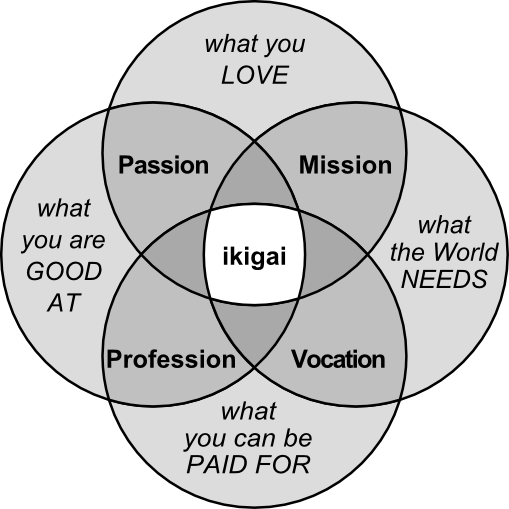
It is generally believed that one’s ikigai can be found at the intersection of four areas of one’s life:

#1 What you love.
#2 What you are good at.
#3 What the world needs.
#4 What you can be paid to do.

Imagine that sweet-spot where you are doing something that you love, you are good at, the world needs and you can be paid to do it!  That is ikigai.  It is that place where your passion, profession, mission and vocation come together.  As I said earlier, it gets you up in the morning.

I want people to succeed.  To this end I study the successful lives of people throughout history.  I seek through the disciplines of philosophy to better see and understand life so that might develop methods to make myself and others more successful and prosperous.  I like the concept of ikigai because it draws together all the elements necessary for our success in any venture.  We like to believe that we are purely rational creatures making decisions based on our noble beliefs and logical understanding.  This is largely bunk.  We are irrational and emotional creatures with a capacity to use reasoning.

We try to remain rational but our emotions make most of the decisions and our reasoning minds tag along for the ride.  If anything, our rational mind and our emotions and spirit are usually at odds with each other.  The rational mind rarely fares well in these conflicts, retreating to a corner and licking its wounds while finding logic to justify our largely illogical choices and decisions.  All too often our minds are slaves to our fears, being made to generate sound reasons for avoiding risk and keeping the status quo intact.  “If it isn’t broken then why fix it?” we intone to justify remaining as we are, regardless of our state of being.

This is not the best way to live life.  This is surviving, not thriving.  Those throughout history who were happiest and healthiest followed their hearts and their dreams.  They used their passions to face their fears.  They were not content to keep what they loved, what they were good at, what they were paid for and what the world needed in separate boxes of their lives.  The successful in life fused these four together to fuel their efforts and generate success in all areas of their lives.  It did not matter if they were striving in school, working through their career, starting a new business, creating art, perfecting their baking, or losing weight; those who succeeded did so with every facet of their being.  They knew largely how to harmonize their emotional and rational minds to resolve the conflict and overcome the inevitable fears that block the path to their success.

We are each a mixture of loves and fears along with experiences and memories. We have been endowed with a marvelous mind that can think, innovate and create.  We can tame our fears and we pursue out loves.  We can give our lives purpose.  This purpose will drive all that we work to achieve.  Yes, ikigai gives us a reason to get up but it also brings meaning to everything that we seek to accomplish.

Without ikigai all our noble efforts will be shaky at best.  Without a core purpose then we will naturally question following any goal.  If we wonder why we are here at this time and place then we will wonder the purpose of doing anything whatsoever.  How can such uncertainty succeed?  In contrast if we have a core purpose fueling our every breath then we will put our entire being into every goal that harmonizes with our ikigai.  If weight loss facilitates our ikigai then we will lose weight.  If prosperity helps us to follow our ikigai then we will strive to prosper. If you have united your passion, your mission, your profession and you vocation then you can use that to succeed in all your dreams and hopes.

And so I commend you to seek your own unique ikigai. Stop fumbling with lesser goals.  There are many who are content with very little.  They shed their quests for fame and fortune and followed a path with heart.  They face their fears daily and overcome them.  Still others prosper that they might fulfill their deeper purpose.  All their goals are full and meaningful because they are tied to their central ikigai.  If you have found your motivations flagging and you are asking a lot of ‘whys’ then that is your opportunity to discover your ikigai.  Follow those ‘whys’ as far as they will take you.  If you can satisfy your own questioning mind and inquisitive heart then an amazing treasure awaits and the Okinawans have named it ‘ikigai.’ 

©2016 S.D. Wilson

Wednesday, 16 December 2015

The Language of Your Life

The Language of your Life

©2015 Scott D. Wilson
 
“Life is a foreign language; all men mispronounce it”  ― Christopher Morley
 
Depending on your view language is either mankind’s greatest invention or its greatest gift.  Language enables us to share and transmit ideas, feelings and experiences in creative ways.  We take it for granted as we use it daily, but language is one of our most powerful tools.  Language has been used to change countless lives and even to forge the events of history itself.  Language is the programming code for our minds.  The way we speak reveals a lot about our upbringing and our background.   Our speech also shows the inner workings of our mind and thoughts.
 
If you close your eyes and imagine then you can likely think of countless examples of speaking patterns that you have encountered throughout your life: 
 
  • the clipped speech of a police officer who has pulled you over
  • the colourful drawl and homespun words of a rural western American 
  • the loud and vibrant language of a passionate evangelical preacher
  • the rough profanity-laced dialogue of a hard-living miner
  • the carefully measured words of a suit-and-tie executive speaking to the board
  • the angry venom of a native New York cabbie who just got cut off by another driver.
  • the gentle tones and soft language of a counsellor consoling a grieving spouse
  • the serious and grave dialect of criminal judge handing down a severe sentence
 
My point is that words themselves and how they are delivered vary immensely and carry with them more than mere information.  In a sense, we paint a picture with our language.  We study the ancient cave drawings in the hope to understand prehistoric communications.  We know that our development of words literally took the place of those early cave paintings.
 
Yes, we use language to convey ideas, images, feeling and experience.  In essence, we use speech to share a piece of our lives or a moment of our living.  Ah, but allow me to expand the vocabulary of this discussion.  The deaf use words but they convey them through gestures and signs.  The blind read but they must use texture and form.  So communication is not limited to words on page or the oration from our mouths.  Of course we have all heard of body language but that is not really what I am talking about here.
 
I am talking about the very dialogue of our daily living.  Every day we get up and go about living our lives.  How we do this communicates to universe itself and to others.  The vocabulary of our actions speaks volumes to our character and our attitude.  We may quietly whisper our gratitude through the act of prayer and meditation.  We may loudly proclaim our anger and frustration through our surliness or sullen attitude.  We might chat our joy brightly through our beaming smile and happy demeanor.  Perhaps we speak slowly and deliberately with our careful behaviour and cautious nature.  Or perchance we might zip off the quick staccato of our nervousness.
 
What I am saying here is that our behaviour speaks as truly as our words.  Our lives are like that cave wall thousands of years ago.  We paint upon it our communications to others and to the world around us.  I am asking you, reader, to consider what kind of message you are sending with your life.  Is it a deliberate and positive message that others will want to read and understand?  Or possibly are you randomly scrawling on the walls of your lifetime?  Today, you have the chance to become aware of the messages that you have been sending.  Look back and try to read the words that you have been living.  Do they contain hope?  Love? Trust?  Fear?  Bitterness?  Despair?
 
Life is meant to be deliberately lived.  If we intend to succeed we need to look not only at what we are saying to others with our words but also what we are saying with our demeanor, our attitude, our dress, our deportment… our entire lives!  Make sure your whole message is worth hearing!
 
“In the end, we'll all become stories.”  ― Margaret Atwood

Monday, 2 November 2015

Know who you are!

Know who you are!

©2015 Scott D. Wilson

High on the side of Mount Parnassus sits the Temple of Apollo and Oracle of Delphi.  Prominently inscribed on the temple walls are the many Delphic maxim.  Among the most famous of these proverbs by far is this one:

γνῶθι σεαυτόν

In ancient Greek it reads "Gnothi seauton" which translates simply to "Know thyself."  Great philosophers and thinkers through the ages have pondered and expounded upon this aphorism.  It seems like such a trite statement: Know yourself.  I mean honestly, we spend twenty-four hours a day with ourselves from cradle to grave.  One would think that we would get to know ourselves pretty well during that time so why bother advising us all to do so?  Surprising, I do think this is often the case.  It has been my experience that we do not tend to pay attention to the commonplace things in our lives.

Unless we come to the point that we are gasping for breath we rarely pay attention to the air that surrounds us.  Until we have been significantly deprived of nourishment then we seldom truly relish the complete experience of food.  It is only when we lose someone significant that we start to understand the depth and breadth of their impact within all the parts of our lives.  So I purport that we humans have a tendency to take ourselves for granted and that we do not truly understand our own hearts and minds very well.  Oh sure, we all carry around an image of ourselves within us but we are constantly amazed when that image is challenged by our own actions and reactions.  We are quite often our own worst enemies and so many of us are perplexed by this fact.

The great Chinese general and strategist, Sun Tzu well understood this important reality of our situation:

“If you know the enemy and know yourself, you need not fear the result of a hundred battles. If you know yourself but not the enemy, for every victory gained you will also suffer a defeat. If you know neither the enemy nor yourself, you will succumb in every battle”

In our daily situation the enemy and our self are one and the same thing.  It is no wonder that we struggle so often with ourselves and with others.  Clearly, it is much to our advantage to overcome ourselves and thereby succeed in our lives.  To do this we need to truly understand and know ourselves. This is not an easy goal.  Since we drew breath we have been told who we are by others and we have likewise formed our own opinions over time.  We have great investment in these personas and identities.  We like to believe ourselves kind, generous or wise.  We enjoy such labels as being ‘a good father’, ‘a great friend’ or ‘a considerate lover.’  We have unquestionably accepted many titles on our journey through life, both complimentary and degrading.  And when our behaviour does not match a hard-held belief about ourselves then we experience confusion and frustration.

So we are thus confronted with the ancient adage to know ourselves.  To follow this directive takes action.   We must sincerely make the effort and take the time to get to know ourselves.  One needs sober and honest reflection on one’s own actions and reactions.  We are required to put aside the images that we have of ourselves and the identities that others have given to us.  Only then we can truly and honestly ask ourselves who and what we are.

I challenge you to reflect upon your life so far and the actions that you have taken.  Have you been cruel?  Have you been kind?  Were you thrifty or wasteful?  Gentle or harsh?  Look at your emotions and your thoughts.  Seek to be objective.  Neither defend nor criticize yourself.  Above all, try your utmost to be brutally honest but gentle with yourself.  In all likelihood what you learn will both amaze and terrify you.  You will need to gently accept your faults and humbly accept your virtues for both of these aspects define you in all your uniqueness.  You are both saint and sinner, light and dark.  This is okay.

Many reading here must wonder about the payoff of such efforts.  Self-reflection is often painful when we face dark truths about ourselves.  It can also be rewarding as we take inventory of virtues that we have been denying.  Above all, I believe that learning about ourselves helps us to become more effective and successful in our daily efforts.  We interact better with others when we understand who we truly are and who we are not.

From my own experience, I list here below but a few of the many benefits of following the sage advice to “Know thyself”:

  • You are equally immune to flattery and insult.
  • You accept yourself and in so doing accept all others as they are.
  • You become invulnerable to coercion and corruption because you know what you need and why you need it.
  • You see that your worst fears guard the pathways to your most passionate dreams.
  • You realize that peace, love and happiness are not destinations.  They are the pathway.
  • You understand your connection with your environment and source for all life.
  • You develop the awareness that you cannot give without receiving or take without losing. 
  • You know that hatred gives energy to the things that you hate and so you selfishly conserve your energy and forgive.
  • You see the difference between knowledge and wisdom… and choose wisdom.
  • You lose the words I’ll try, I think, I hope and I might.
  • You use the words I will, I can, I have, I am, and I shall.
  • You see with clarity your own folly, flaws, errors and failures and face them without excuse or self-pity.
  • You acknowledge and accept the darkness within your own soul.
  • Knowing your own short-comings and imperfections you extend gentleness, kindness and love towards the harsh cruelty, fear and selfishness of others.
  • Humbly you accept your talents, gifts and virtues and take responsibility to act on them.
  • You become free to love abundantly without restraint or conditions.
  • Looking outwards you see this world with new eyes.  Nothing changes and yet everything does!

And lastly, you will be able to follow the last directives written at the Oracle of Delphi…

    Παις ων κοσμιος ισθι – As a child be well-behaved
    Ηβων εγκρατης  – As a youth be self-disciplined
    Μεσος δικαιος  – As of middle-age be just
    Πρεσβυτης ευλογος  – As an old man be sensible
    Τελευτων αλυπος  – On reaching the end be without sorrow

Tuesday, 13 October 2015

Playing the Game

Playing the Game
®Scott D. Wilson,P.Eng.

"Life is like a game of cards. The hand you are dealt is determinism; the way you play it is free will." -Jawaharlal Nehru


Have you ever had someone say to you "Get your head in the game!"? Well one way to look at life is through the model of a game. You roll the dice. You make your moves. And you have some fun in the playing. Life is full of both joy and tragedy. To focus on either side is folly. Today, I suggest that we get our head in the game.

Genetics, birth circumstances, upbringing, family, geography, and so many more factors, these are the hand that we are dealt. We did not choose the game. The game chose us. Ah, but then we have this thing called 'choice'! We have the power to choose what we will and will not entertain in our lives. We have the power of doing and not doing, being and not being. What we take away can be priceless: experience.

If we pause in our gameplay and reflect on the moves we made, how we played our cards and the outcomes that we achieved then we can begin to see the patterns of cause and effect within ourselves and in others. Results are not random. We are not victims of our circumstances. Our choices have profound effects on ourselves and our world. We can become better gamesmen. Life can be hacked. We can up our game. Wisdom does not come by chance or accident. It is intentional. It is a choice too.

So whether you are on fairway or off in the rough, on the court or on the sidelines planning your next move, remember that you can always choose to look back and learn from how you played so far. There is always chance to learn and improve. Life is always there to teach you the lessons that you need to succeed. Circumstances are not an excuse not to play or improve. Your choices will both empower you and define you. It is the experience that counts so let's make experience that we can count on! Have fun and remember that nobody gets out of this alive so play it all with gusto!

"You have to learn the rules of the game. And then you have to play better than anyone else." -Albert Einstein

Cheers!

P.S. Although life can be considered a game we should be aware that it is not a competitive one against the all the rest of humanity. If played well then everyone should win!!!

Nickelback - When We Stand Together

Thursday, 3 September 2015

Wonderlust

Wonderlust
©Scott D. Wilson 2015

I have said elsewhere that I was blessed to have found a friend that I can call my mentor. The times we have spent together have been golden and I have been forever enriched. One statement that my friend is fond of repeating is "Read it again for the first time."  It is a wonderful paradox, and it has been the source of so many incredible personal revelations. 

The Zen Buddhists and Japanese martial artists seek a state of mind called 'shoshin' meaning the "beginners's mind."  It refers to an attitude and view marked by eagerness, openness and without prejudice or preconception. This is the way an avid novice approaches a new activity or subject of study. It is a view full of limitless possibilities.

As we grow and experience life we accumulate knowledge and wisdom.  By necessity, we often must accept much of what comes to us as it is presented. We rarely question interpretations or understanding. For these reasons we also tend to accumulate prejudices and preconceptions. We believe that we are becoming experts about life and reality.

We think that we hold *the* truth.  By believing this error and accepting much of what others have told us we ironically grow in ignorance and folly.  We gradually lose our questioning mind and attitude. We similarly become more and more defensive of our views and truths because anything that contradicts them threatens our understanding and reveals our possible ignorance and error. Fear displaces wonder. 

There are other consequences. Sadly, we become increasingly jaded by life. It all becomes "Been there. Done that."  We lose the sense of amazement and excitement that children have when they experience something for the first time. It is this 'wonder' that is lacking so much in the lives of so many! We rob ourselves of the joy of learning.

The Zen folks have another term they use in conjunction with 'shoshin.' It is the phrase "new eyes."  They, like my mentor, encourage us to look at life again... for the first time. There is so much that we miss in this world because we do not indulge our natural sense of wonder and curiosity. I have discovered so much by simply pensively questioning my own views and the 'truths' of those who moulded my life... to again ask "Why?" and to ponder the possibilities.

And so I currently lust to regain much of my childlike sense of wonder!  I yearn to see this universe with new eyes. I seek to discover what I thought I knew. It is not always comfortable. That I will admit. It is often humbling, realizing how little I truly know and understand. I can tell you that it has been worth it though! You will find some irrefutable and unquestionable truths that will lead you on paths of amazement and discovery.  And thus I similarly encourage you all in your own wonderlust!