Search This Blog

Tuesday, 13 December 2016

Frivolously Important


Frivolously Important

©2016 Scott D. Wilson


Life is far too important to ever take seriously.” –Oscar Wilde & me


I distinctly remember when these words first came to me.  I was in a church parking lot talking to a friend one evening when they came to my mind and I spoke them aloud to him.  I decided then and there that they would be part of my life motto.  It was a few months later that I found that Oscar Wilde had sort of beaten me to the punch; he had said “…life is far too important a thing ever to talk seriously about it.”  Time and the internet morphed his words and you will find the quote above attributed to him.


I will tell you why I think this statement is important.  First of all, it is paradoxical.  I have found that the most profound truths live in paradoxes.  Consider “Love you neighbour as yourself.”   That is a profound paradox concerning the balance between the selfish and the selfless.  Another paradox, the most valuable things in life are free:  life, family and friends.  Where you find a paradox you will likely find valuable wisdom.  My quote today is of equal significant.  This life is important.  It is deeply and extremely important and not to be treated lightly.  That is all the more reason not to kill it with seriousness.  The one thing that virtually everyone, including myself, takes too seriously is ourselves.


All our problems seem larger than life, everything we do seems all important.  Our successes and failures are all-consuming. We invest huge amounts of serious time and emotion into ourselves.  And when life upsets our apple cart we react as if the world itself was ending.  We fail to put our existence into perspective.  We fail to see ourselves as brief unique miracle in the vast timeline of human history.  We take for granted our very existence, forgetting the world before our birth and neglecting the reality after our inevitable death.


As we strive towards success in life let us remember the sacred preciousness of our lives and treat ourselves less seriously.  Imagine that you had a mission of utmost importance that required you to drive for several days across America from one coast to the next.  There would be long hours in the close quarters of a vehicle, and cramped nights in the dingy rooms of roadside motels. Would you choose serious and sombre companions or would you bring along some cheerful, light-hearted and humorous friends?  Your life from cradle to grave is the most important journey that you will ever take.  Keep it joyful.  Don’t take it too seriously.

Wednesday, 16 November 2016

Motivation: Hacking Your Emotions


Motivation: Hacking Your EmotionsBy Scott D. Wilson


In the game of motivation that is played to achieve success there are two players:  our rational mind and our emotional mind.  The rational mind foolishly thinks that it is in charge.  Nothing could be further from the truth.  Without the emotional mind there would be no energy or drive to our actions.  We need the power generated by the emotional mind to fuel all our noble endeavours.  Yes, in the very short term we can use pure logic and reason to start an action, but eventually the emotions will demand a tangible pay-off in order to sustain a worthwhile behaviour or to continue towards a meaningful goal.  No matter how logical or how important an idea may be, we won’t make the effort to put it into effect if our emotions do not support it, at least not in the long run.


Often our emotional mind gets tired.  It sulks like a child and it wants what it wants and it does not care what our rational mind knows.  We lose our motivation.  Here is where most rational minds fail.  They attempt to bully and coerce the emotional mind into bending to their sheer willpower.  They use guilt and shame in an attempt to force the emotional mind into co-operating with the logical and reasonable plans.  This generally fails utterly and the person then blames their lack of ‘willpower’. 
The root of the word willpower is willing. If your rational mind forces any issue then there is no willingness.  The source of power in one’s will is based on the willingness behind it.  The emotions must be engaged for willingness to have any power.  Willpower consists of rational thought that provides a vector of constructive direction and emotions that supply the necessary power.  Without emotions in harmony with a logical plan there is only empty intention.  It is, at best, a wish.


You are not a logical creature with emotions.  You are an emotional creature with reasoning.  Deal with the emotions.  If you want motivation you need to use your rational mind to entice your emotions.  Yes, entice, as in ‘to attract or tempt by offering pleasure or advantage’.  Figure out what motivates your emotions.  Do rewards act as your best incentives?  Then set up action charts that provide rewards when certain tasks are achieved.  Doe fun help you during mundane tasks?  Find things that you can use to pep you up and make your work towards your goals more enjoyable and less dreary or tiring.  The answers are very personal.

Each of us has different things that excite and entice us.  Take the valuable time to find yours! Do whatever it takes to provoke your emotions into action.  Find the pleasure or advantage that puts emotions behind your intended actions!!   If you need to restore your motivation then hack your own emotions and take the necessary steps to funnel their energy towards your goals!


©2016 S.D. Wilson

Friday, 11 November 2016

Letter to a Fearful Warrior

Image result for reluctant warrior
Letter to a Fearful Warrior

Dear Warrior,

The end of this life is inescapable. Death comes to everyone without exception. So how you fill the time between death and birth is the only matter of importance. What have you to fear? What are you afraid to lose? Can you really fail?

Feel the brevity of life. Yet do not despair. Rejoice! Allow the urgency of it to infuse your decisions and actions. A warrior who hesitates in battle suffers defeat or worse. Truly, tomorrow never comes so make the best of all that you are and all that you have NOW.

A blade remains useless in the scabbard. A sharp mind remains useless sheathed with inaction. Be a person of action. Overcome the paralysis of fear and uncertainty. Turn and face the enemy knowing who you are. With stillness inside, move rapidly and with purpose. Yield and overcome.

Again warrior, what do you fear? In the end all is lost when the ultimate gift is returned to the giver. In this sense nothing is truly yours to begin with, including your own life. Until the time of your end you must continue to overcome the enemies on your path. They are fear, knowledge and power. Fear blocks your path to knowledge. Knowledge unapplied becomes and addiction that blocks your way to power. Power intoxicates and blocks your way to overcoming yourself.

What is timidity to one who knows that death is his lifetime companion and that each moment may be their last? The past is gone and all it can offer you are its lessons and the wisdom that arises from refection upon it. There is no future, there is simply now. Do what needs doing now. Remember the wise words of Don Juan Matus:

A warrior must focus his attention on the link between
himself and his death. Without remorse or sadness or worrying, he
must focus his attention on the fact that he does not have time and
let his acts flow accordingly. He must let each of his acts be his
last battle on earth. Only under those conditions will his acts
have their rightful power. Otherwise they will be, for as long as
he lives, the acts of a fool.
When one has nothing to lose, one becomes courageous.
We are timid only when there is something we can still cling to.

Today and this moment are yours. Be the warrior that you were meant to be, not an ignorant commoner paralyzed by fear and mortality. Live knowing that death is at hand for any one of us. Love with all your heart. Act without hesitation, knowing the shortness of life. Overcome your enemies. Follow the path with heart, the path with passion. Become impeccable in thought, word and action. You truly have nothing to lose and you have everything to win!

©2016 S.D. Wilson

Tuesday, 13 September 2016

They Are All Broken


They Are All Broken

By Scott D. Wilson

Have you ever been betrayed or let down by someone that you had believed in or trusted?  Have you found yourself questioning the behaviour of someone that you thought that you knew?  I will share something with you that has taken me over forty years to fully realize:  They are all broken.  Every single person out there is broken, including you and including me.  We just don’t see the brokenness all the time because most have learned to hide it well… from others… and from themselves.

I have prided myself in the past by giving everyone the benefit of the doubt.  I used to say that I started all people at one-hundred percent and that they worked themselves down from that.  I thought this was the best way to look at others.  Now I realize that it was terribly unfair.  It always set me up for disappointment.  It placed unrealistic expectations on my fellow travellers in this world.

Believing the best in others means looking at them but not seeing them.  It is like looking for flawless diamonds with a dirty magnifying glass.  Imperfections are smudged and hidden.  As individuals, we have been taught to show our best sides.  Eventually, we will have to clean our lenses.  Inevitably, we see the darker side to someone.  They fail to live up to the image that we have constructed of them.  They naturally act out of fear or insecurity.  They act out of character, and we feel cheated or misled.

Yet you see, the problem is truly not with them but with us.  We are mad with ourselves for failing to see them accurately or properly.  We forgot that they are all broken like us.  One might wisely ask why I say that ‘they’ are a broken if in fact we all suffer the same affliction.  Should the statement not be that ‘we’ are all broken?  Yes, this is true, but not so when make the observation.  For we are not thinking in terms of our own sins and evil when we with judging eyes see the brokenness of those around us.  There is no ‘we.’  There is only ourselves and them.

We all lie to one extent or another.  If we are honest in our observations we will come to realize that we lie to ourselves far more than we lie to others.  We paint over our own imperfections.  We try to see ourselves in the best light.  We soothe our egos by favorably comparing ourselves with others.  In short, we do not see ourselves as broken.  So it is when we are betrayed or disappointed that we plainly see the failings in those who we had painted with our ideals.  We do not sympathize or empathize with their plight. We judge them.

We have disconnected from our own brokenness and become harsh. We feel victimized and wonder why they won't treat us as we treat them. If we want to correct this we first must remember that they are all broken.  Life has made people damaged goods.  We need to expect that they will operate from that brokenness, and enjoy surprise when they choose to be better.  We then must turn inwards and acknowledge our own broken state so that we can let go of judgement, bitterness and resentment. Here we can ultimately remember that we are all broken.    

I am not making this observation to be pessimistic or cynical.  I have come to this realization through hard experience.  It is not optimistic to deceive ourselves about the fallen state of our friends and family.  It is not realistic to ignore our own flaws and shortcomings.  If we see that each one of us has some chips on their heart or cracks in their mind then we can treat those people with kind understanding. When necessary, we can take proper actions to protect and prepare ourselves from the broken actions of others rather than becoming victimized. If we can be gentle with our own faults then we can extend that gentleness towards those around us.  

When next you are disappointed by friend or family do your best to stop and remember that they are broken.  You are the one who expected too much.  Remember the cracks in your own spirit and the bruises on your own soul.  You too are broken.  The only way to help mend such damage is to handle each other softly.  For it is when all the broken pieces are gathered and gently reassembled that true wholeness is achieved.  

P.S.  I am not implying that it is wrong to see the potential and good in others. If we did not see such light then we would soon be mired in cynicism and disenchantment. As the Desiderata wisely states “many persons strive for high ideals; and everywhere life is full of heroism.”

The harm to us comes from our expectations that others, especially those closest, will always operate ideally. First, we cut ourselves no slack and then we do likewise to others.

“They are all broken.” is to be used to remind ourselves that we are judging unfairly. It is my mirror to myself that tells me that I am expecting ideals in a less than ideal world.


Monday, 15 August 2016

Powerfully Soft

Powerfully Soft

By Scott D. Wilson, P.Eng.

“Be soft. Do not let the world make you hard.Do not let the pain make you hate.
Do not let the bitterness steal your sweetness.
Take pride that even though the rest of the world may disagree,
you still believe it to be a beautiful place.” – Iain S Thomas

And consider:

“A man is born gentle and weak.
At his death he is hard and stiff.

Green plants are tender and filled with sap.
At their death they are withered and dry.
 
Therefore the stiff and unbending is the disciple of death.
The gentle and yielding is the disciple of life.

Thus an army without flexibility never wins a battle.
A tree that is unbending is easily broken.

The hard and strong will fall.
The soft and weak will overcome.” – Tao Te Ching - Lao Tzu - chapter 76
 

This world largely ignores the power of softness.  Yielding is considered weakness.  Being gentle is equated with being feeble.  Yet the most powerful people of history have demonstrated the power of submission.   Ghandi’s successful peaceful protests, Martin Luther King Jr.’s non-violent marches and the fall of the Berlin Wall are just a few examples of the soft overcoming the hard.


However, the world is increasingly applying harder and harder efforts to counter-act the destructive forces in it.  Force is countered with greater force.  The effectiveness of these strong measures gradually grows less and less by the day.  It is much like trying to dig a deep hole in a large sandy beach, the more one digs, the more sand pours into the hole from the surrounding dunes.  What first took only a small effort to correct now takes tens and hundreds of times greater effort.  Conventional thinking would do well to consider the wisdom cited above and develop some softer methods to defeat the enemies of the peace.


The wise see the folly in meeting might with might within themselves and their own lives.  They learn to yield and redirect the opposing forces that assail them.  In martial arts we generally learn the hard forms first: kicks, blows and blocks.  As one trains for many years it becomes apparent that strength and force have their limits and overcoming force with greater force is not truly effective.  Eventually, adept martial artists will learn the soft styles and discover their immense power.  When sagely applied, the most effective martial arts overcome enemies by preventing them from ever entering into conflict.


Resistance often strengthens our foes.  Better firewalls and virus protection generate more ingenious methods for hacking into our systems.  One of the most powerful tools in preventing cyber-attacks against corporations is the ‘honeypot.’  Cyber-criminals want to break in and steal data.  The honeypot provides them with what they want.  It is an area filled with interesting data and it is somewhat secured so that significant effort must be made to get there. However, honeypots are carefully monitored. All who enter are traced and their actions are tracked meticulously. The data there is safe and expendable or even misleading.  Sometimes, giving people what they want is the best way to defeat them.


How does this apply to you and me?  It means that we pay attention to hardness and unyielding in our own lives.  Society has conditioned us to instinctively hit back when something strikes at us, to overcome force with greater force.   Wisdom understands that taking blows and returning them is not always a beneficial strategy.  Over time, this reaction can ‘harden’ us mentally and emotionally.  Our greater strength turns into weakness as we become emotionally brittle and mentally inflexible. 

We need to ask ourselves: Are we pushing back out of fear?  Can we let the hard words and harsh comments of others pass us by allowing them to dissipate into silence?  Can we agree with the truth in our opponents words and yet overcome their destructive meaning?

“Why yes, I am a bit lazy at tidying the house. Since you are better at this than I am then perhaps you would like to help with this and show me how to do it better.”

Yielding is a very powerful tactic.  It disarms many enemies who are accustomed to resistance or counter-attacks.  In physical combat, a blow that misses its target tends to leave the attacker over-extended and prone to being pulled off balance.  The aggressor needs the resistance to their attack in order to stop from fumbling forward.  In Tai Chi Chuan we call this uprooting an opponent, making them unstable and vulnerable.  In social interactions opponents lose their emotional energy when others ignore their words or essentially agree with them.  Antagonists become somewhat prone under these circumstances and I have seen many back-peddle, literally trying to ‘take back’ their words.

So when we reflect on our daily struggles let us make sure that we are not hardening our thoughts and our emotions.  Do not let pain or bitterness make us fragile.  Consider the wisdom of those who advocate gentleness and the power of letting go.  Just as water softly overcomes stone we too can overcome our hard opposition.   The next time life pushes you, stop before you instinctively shove back.  Consider the possibility of yielding and sending the force tumbling behind you as you choose to keep moving forward. 
 
 
*Post Script*


As a reminder for myself, I have this version of Chapter 22 of the Tao Te Ching on my wall (emphasis on the last sentence):
  
Yield and overcome;
 bend and be straight.

Empty out and be full;
 wear out and be renewed.

Have little and gain;
 have much and be confused.

Therefore, the True Person embraces the One
 and becomes a model for all.

Do not look only at yourself,
 and you will see much.

Do not justify yourself,
 and you will be distinguished.

Do not brag,
 and you will have merit.

Do not be prideful,
 and your work will endure.

It is because you do not strive
 that no one under heaven can strive with you.

The saying of the Old Ones, "Yield and Overcome,"
 is not an empty phrase.

True wholeness is achieved
 by blending with life.
 
 ©2016 S.D. Wilson

Thursday, 28 July 2016

A Winning (and Thinning) Attitude

A Winning (and Thinning) Attitude

By Scott D. Wilson
 
“Your attitude, not your aptitude, will determine your altitude.” –Zig Ziglar

 
I should preface this post with some background.  I have been a moderator Lose It (www.loseit.com) for close to two years now. I have seen many faces come and go. I have seen success stories and I have seen tales of defeat. Suffice it to say I am becoming more and more experienced in understanding what makes for success and failure in weight loss. This of course ties to my passion about success and all the factors that contribute towards it.  So allow me use my experience at Lose It to share a key observation about success.
There are a lot of factors and criteria surrounding success. There is however one condition that I have seen time and time again that factors highly in both success and failure. That one condition is attitude. I will say up front that good attitude may not guarantee success but a lacklustre attitude is almost assured failure. On websites, like Lose It, words are the thermometer of our attitude.
The deadly words I see people using every day are these “trying”, “hope”, “want”, “wish” and “but”. The first four words all lack real commitment. The minute we say “I am trying, hoping, wanting, wishing…” we leave room for doubt and failure. Mentally we are not committing. We are hedging our bets. We are playing it safe. Commitment risks failure, and we do not want to risk failing. When our attitude is committed the deadly failing words leave our vocabulary and are replaced with the words “am”, “will”, “intend”, “have” and “shall.” These words stem from self-assurance and commitment.
Some will likely object to my last word, “but.” However, I assert that the use of the word “but” is very important. Most of the time when we use “but” we completely invalidate what we said beforehand. We are using “but” as a safe way out. Example: “I am working at losing weight but it just seems too hard.” All that is really heard and meant is the statement after the “but.” I have a suggestion. Try this little experiment: catch yourself saying or writing “but” and replace it with “and” instead. So my example becomes “I am working at losing weight and it just seems too hard.” This sentence owns everything. The two thoughts are joined, no longer dismissing the first with the second. By taking away the “but” we are no longer using it to make excuses.
Another deadly attitude indicator for me is what I refer to as ‘victim talk.’ Victim talk is characterized by a ‘woe is me’ attitude and a failure to take responsibility for one’s actions and their ensuing results. The victim is never at fault. The problem always rests with friends, families, colleagues, the environment, willpower, motivation, genetics, medications, hormones, age, upbringing… you name it. It never has anything to do with the victim’s own actions or inactions. The world is just giving them a bum deal. They ‘try’ but they just never seem to win. On Lose It ‘victim talk’ is full of elaborate explanations and heartfelt justifications for why the person cannot log, exercise or stay on budget. Victim talk always justifies staying the same. Change is always too hard.
Yes, we all have bad days. Yes, our attitude can suck at times. Yes, our motivation can fail us. Yes, we all can feel victimized sometimes. I completely get that fact. However, the longer we linger in these states the lower our chances for success become. The people I see succeeding shed victimhood and weak language quickly, sort of the way a dog shakes itself dry. They have created habits that support positive motivations, and they have motivations that are backed by reasons that they can defend rationally and emotionally.
At this stage, some may be asking how one can change one’s attitude. I know of at least two ways to do this. The first and most significant way involves our use of words, our verbal language. Like the mom with her ‘swearing jar’ we can successfully alter the words that we choose to use. We can recognize the impact of the words that we are using and we can opt to use better words accordingly.
Our thoughts and feelings influence our speech, but most do not realize that our speech can likewise impact our thinking and emotions. Words like Nazi, holocaust, extermination and genocide evoke powerful thoughts and feelings. When we use these words they produce emotions in us and in others. This is neither good nor bad but it is important to understand. The same holds true with the words we use about health and fitness.
When we use positive words about our health and well-being then we evoke positive emotions for ourselves. Words like strength, power, goals, fitness, health, wellness, activity, play and endurance create positive thoughts and feelings. In contrast, words like fat, lazy, exhausting, weight loss, diet, exercise and workout have some negative mental baggage and emotions associated with them. Fat, weight loss and diet all provoke in us negative images of deprivation and hunger. Exercise, exhaustion, lazy and workout arouse thoughts of toil, straining and unrewarding pain. There is a world of difference between the mind that is toiling to lose weight and the mind that is striving for fitness, health and wellness.
My second suggestion to improve attitude is similar to my first one. My second suggestion is to change our body language. Again, our body language can stem from our emotions but we also need to realize that our body language can in turn have a significant effect on our feelings. Here is an example that I have tried. Before you need to speak to others stand for five minutes with your arms akimbo, palms down. This is also referred to as the ‘Wonder Woman” pose. I guarantee that you will begin to feel more confident. Several studies have shown that it works, and here is why.
Our limbic system is an unconscious structure involving the brain that controls how we physically express ourselves. When we are sad our limbic system slumps our shoulders, induces frowning and even alters our breathing and heart rate. Our limbic responses are why lie detectors work to some extent. What is interesting is that we can also use our limbic systems to work in our favour.
When we feel confident we often naturally stand in confident poses, like arms akimbo. The reverse can also be exploited; if we are a bit insecure and we stand for a prolonged time in a confident pose then we begin to feel more confident. We are tricking the limbic system into believing that we are confident and it responds by affecting unconscious reactions like our breathing and muscle relaxation. These in turn affect our emotions and our attitude.
We have all seen this same principle in action with speakers who square their shoulders and straighten their posture as they mount to the podium. They are mentally and physically preparing themselves for confidence. This same principle is used in martial arts through repetitive katas, forms and routines that induce a relaxed state in preparation for a calmer reaction when conflict arises. Even in society we use things like suits and uniforms to instill a natural sense of authority and respect. Donning a uniform often changes our demeanor and attitude.
My overall point is that we can become aware of our body language in the same way that we can become aware of our verbal language. Awareness can be used to make constructive changes to our languages and thereby improve our attitude and our odds for success. We have the ability to affect our attitude by consciously making certain choices. If we change our use of words we can literally change our minds, our way of thinking and our emotional responses. Likewise, if we choose to routinely alter our body language we can affect our feelings and attitude. We can give a boost to our self-confidence.
Confidence is the last area that I want to address in improving our attitude. When we achieve something we grow in confidence. Failure likewise erodes our confidence. Problems arise when failures deplete our confidence to the point where we seek self-assurance before we are willing to even make any attempt. This is like sitting in front of a stove demanding “Give me heat and I will give you fuel!” It doesn’t work that way. We need to start to take some risks in order to make some achievements that will generate further confidence. We need to offer some small belief in ourselves and risk both success and failure. Build upon small successes. Learn from failures and use them to generate new attempts at success.
We can become aware of our words and our language both physical and verbal. We can make choices to change and improve these things and in so doing better our outlook and enhance our confidence. Consequently, we greater our probability for success. Take a look at what you can do today with your attitude in order to better reach your goals. Consider what changes you can make and what actions you can take to help you develop a winning or ‘thinning’ attitude!
 
©2016 S.D.Wilson

Sunday, 17 July 2016

Finding You Ikigai

Finding Your Ikigai
By Scott D. Wilson

Have you ever struggled to stay motivated towards a given goal?  Whether it was sticking to a financial budget, striving to keep a fitness goal or some other beneficial discipline, you just couldn’t seem to muster what you needed to keep your focus.  You are far from alone.  What if I were to suggest that you are only seeing a symptom of your trouble?  Perhaps there is another element missing from your life that would help to put your goals on track.  Perhaps you need to find your ikigai.

When it comes to health, well-being and longevity the world seems to worship at the feet of Okinawa, Japan.  Their lifestyles have been exhaustively studied.  Many diets and supplements have been created from their way of eating.  Their martial arts and meditation practices have been taught and spread around the word.  Although these are all noble efforts it is the more recent focus on the people’s philosophy and thinking that has caught my attention.

You see, in Okinawa there is not real concept for retirement.  People are simply expected to remain engaged in life throughout their entire lifespan.  Oh for sure, people slow down and they may even change occupation but their life experience is constantly being applied in gainful ways.  Central to this way of life is the concept of ‘ikigai’ (生き甲斐, pronounced icky-guy).  The term ikigai is composed of two Japanese words: iki (生き?), referring to life, and kai (甲斐?), which roughly means "the realisation of what one expects and hopes for".  In short, it is "a reason to get up in the morning" or a reason to enjoy life.  Everyone, according to the Japanese, has an ikigai.

There is a TED Talk by Dan Buettner who suggested ikigai as one of the primary reasons for the longevity of Okinawans, and he may be onto something.  For finding one’s ikigai requires a long and deep search of oneself.  Finding your ikigai is akin to finding the meaning of your life.  Ikigai brings value to one’s life and it set our purpose.  Times may be gloomy and dreary and fortunes may be failing but a person who understands their ikigai presses on with intention and resolve.

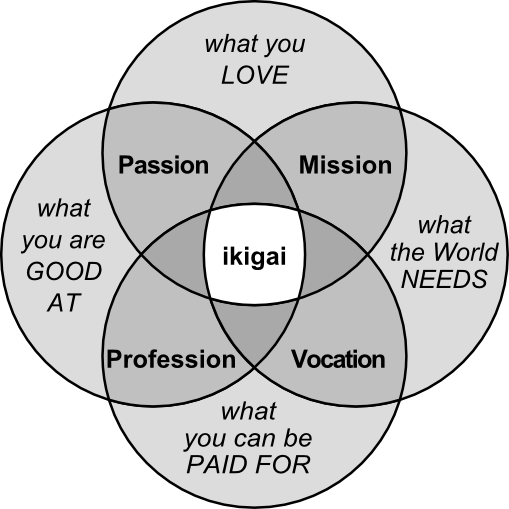
It is generally believed that one’s ikigai can be found at the intersection of four areas of one’s life:

#1 What you love.
#2 What you are good at.
#3 What the world needs.
#4 What you can be paid to do.

Imagine that sweet-spot where you are doing something that you love, you are good at, the world needs and you can be paid to do it!  That is ikigai.  It is that place where your passion, profession, mission and vocation come together.  As I said earlier, it gets you up in the morning.

I want people to succeed.  To this end I study the successful lives of people throughout history.  I seek through the disciplines of philosophy to better see and understand life so that might develop methods to make myself and others more successful and prosperous.  I like the concept of ikigai because it draws together all the elements necessary for our success in any venture.  We like to believe that we are purely rational creatures making decisions based on our noble beliefs and logical understanding.  This is largely bunk.  We are irrational and emotional creatures with a capacity to use reasoning.

We try to remain rational but our emotions make most of the decisions and our reasoning minds tag along for the ride.  If anything, our rational mind and our emotions and spirit are usually at odds with each other.  The rational mind rarely fares well in these conflicts, retreating to a corner and licking its wounds while finding logic to justify our largely illogical choices and decisions.  All too often our minds are slaves to our fears, being made to generate sound reasons for avoiding risk and keeping the status quo intact.  “If it isn’t broken then why fix it?” we intone to justify remaining as we are, regardless of our state of being.

This is not the best way to live life.  This is surviving, not thriving.  Those throughout history who were happiest and healthiest followed their hearts and their dreams.  They used their passions to face their fears.  They were not content to keep what they loved, what they were good at, what they were paid for and what the world needed in separate boxes of their lives.  The successful in life fused these four together to fuel their efforts and generate success in all areas of their lives.  It did not matter if they were striving in school, working through their career, starting a new business, creating art, perfecting their baking, or losing weight; those who succeeded did so with every facet of their being.  They knew largely how to harmonize their emotional and rational minds to resolve the conflict and overcome the inevitable fears that block the path to their success.

We are each a mixture of loves and fears along with experiences and memories. We have been endowed with a marvelous mind that can think, innovate and create.  We can tame our fears and we pursue out loves.  We can give our lives purpose.  This purpose will drive all that we work to achieve.  Yes, ikigai gives us a reason to get up but it also brings meaning to everything that we seek to accomplish.

Without ikigai all our noble efforts will be shaky at best.  Without a core purpose then we will naturally question following any goal.  If we wonder why we are here at this time and place then we will wonder the purpose of doing anything whatsoever.  How can such uncertainty succeed?  In contrast if we have a core purpose fueling our every breath then we will put our entire being into every goal that harmonizes with our ikigai.  If weight loss facilitates our ikigai then we will lose weight.  If prosperity helps us to follow our ikigai then we will strive to prosper. If you have united your passion, your mission, your profession and you vocation then you can use that to succeed in all your dreams and hopes.

And so I commend you to seek your own unique ikigai. Stop fumbling with lesser goals.  There are many who are content with very little.  They shed their quests for fame and fortune and followed a path with heart.  They face their fears daily and overcome them.  Still others prosper that they might fulfill their deeper purpose.  All their goals are full and meaningful because they are tied to their central ikigai.  If you have found your motivations flagging and you are asking a lot of ‘whys’ then that is your opportunity to discover your ikigai.  Follow those ‘whys’ as far as they will take you.  If you can satisfy your own questioning mind and inquisitive heart then an amazing treasure awaits and the Okinawans have named it ‘ikigai.’ 

©2016 S.D. Wilson